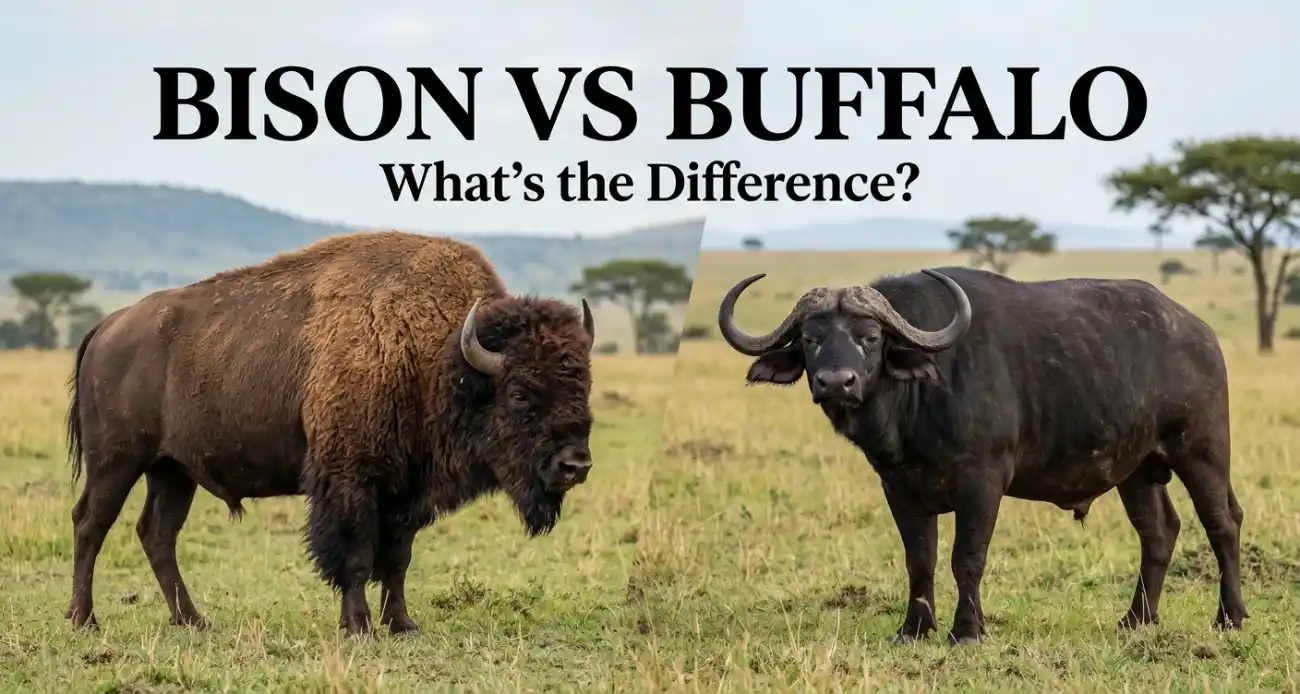
Bison and buffalo are different animals, although Americans often use “buffalo” to mean the American bison. American bison (Bison bison) are native to North America, while true buffalo, such as water buffalo and African buffalo, are native to Asia and Africa. Bison usually have a large shoulder hump, shaggy coat, and shorter horns.
Key Takeaways
- The American animal commonly called a buffalo is actually an American bison.
- True buffalo include water buffalo and African/Cape buffalo.
- Bison have a prominent shoulder hump, thick front-body fur, and relatively short horns.
- Buffalo generally have smoother coats, no large shoulder hump, and longer horns.
- “Buffalo” remains a common and culturally important name for American bison in the United States.
Are Bison and Buffalo the Same Animal?
The short answer is no—not scientifically. Bison and true buffalo are different groups of animals within the bovine family, Bovidae.
The confusion comes from everyday American English. In the United States, people have called the American bison “buffalo” for centuries. The National Park Service notes that both names are commonly used for the American bison, although bison is preferred in scientific and formal contexts.
So if someone in the American West says they saw a “buffalo,” they may very well mean an American bison.
True buffalo, however, are animals such as the water buffalo of Asia and the African or Cape buffalo of Africa.
Bison vs Buffalo: Key Differences
The easiest way to understand the difference is to compare their appearance, habitat, and classification.
Appearance and Body Shape
An American bison has a very noticeable shoulder hump. Its front half is heavily muscled, while the body becomes slimmer toward the rear.
Bison also have large heads and thick hair around the head, neck, shoulders, and front legs. This shaggy appearance is especially obvious during the colder months.
True buffalo have a different body shape. Water buffalo are large and powerful but generally lack the dramatic shoulder hump seen on bison. African buffalo are also muscular and heavy, but their bodies have a smoother profile.
Horns and Head
Horns provide another useful clue.
Bison have relatively short horns that curve upward. Their large heads and thick facial hair give them a rugged appearance.
Water buffalo generally have much longer, sweeping horns that can curve outward and backward. African buffalo have distinctive horns that spread outward and form a heavy boss across the forehead in mature animals.
If you see a shaggy animal with a huge shoulder hump and comparatively short horns, you are probably looking at a bison.
Coat and Climate
Bison are well adapted to cold North American environments. Their thick winter coats help them handle harsh prairie weather.
During winter, bison can use their powerful heads and neck muscles to move snow aside while searching for vegetation. The National Park Service specifically notes the importance of their shoulder muscles and hump in this behavior.
Buffalo species are generally associated with warmer regions of Africa and Asia. Water buffalo, for example, have long been closely connected with people and agriculture in many Asian regions.
Habitat and Range
American bison are native to North America. They historically occupied enormous areas of the continent, particularly grasslands and plains.
True buffalo are native to the Old World. Water buffalo originated in Asia, while African buffalo are native to sub-Saharan Africa.
That geographic difference is one of the simplest ways to separate the two groups.
What Is a Bison?
A bison is a large mammal belonging to the genus Bison.
There are two living bison species: the American bison (Bison bison) and the European bison (Bison bonasus). The American bison is the animal most Americans picture when they hear “buffalo.”
American bison are famous for their role in the history and ecology of the Great Plains. They are also the largest land mammals in North America. Adult males can reach roughly 2,000 pounds, according to the National Park Service.
American Bison
The American bison is divided into two commonly recognized subspecies: the Plains bison and wood bison.
Plains bison are associated with the grasslands of the Great Plains, while wood bison are larger and adapted to northern forest and wetland environments.
Today, bison remain an important symbol of the American West and an important conservation success story.
What Is a True Buffalo?
The word “buffalo” properly describes several Old World animals, particularly the water buffalo and African buffalo.
Water Buffalo
The water buffalo (Bubalus bubalis) is native to Asia and has both domesticated and wild forms.
Domesticated water buffalo have been important to people for centuries. They are used in agriculture and are valued for products such as milk and meat.
Their large, curved horns and relatively smooth bodies make them easy to distinguish from the shaggy American bison.
African or Cape Buffalo
The African buffalo, also called the Cape buffalo, is native to sub-Saharan Africa.
It is a powerful, heavily built animal with distinctive horns. Unlike domesticated water buffalo, African buffalo have not been domesticated.
Although all these animals belong to the broader Bovidae family, they are not simply different names for one species.
Why Do Americans Call Bison “Buffalo”?
This is where the bison vs buffalo confusion gets interesting.
Early European explorers and settlers encountered the large, shaggy animals of North America and used names associated with animals they already knew. One explanation connects the word “buffalo” with the French bœuf, meaning beef or ox. The exact history of the name is more complicated, but the nickname became established.
The term eventually became part of American language and culture.
There is also an important cultural point: “buffalo” should not simply be dismissed as a wrong word. The National Park Service notes that many Indigenous communities prefer the term buffalo in cultural contexts.
In scientific writing, however, “American bison” is the more precise name.
How to Tell a Bison From a Buffalo
If you are trying to identify one in a photograph, remember these simple clues:
Bison:
- Large shoulder hump
- Huge head
- Thick, shaggy front coat
- Beard-like hair around the chin
- Shorter, curved horns
- Native to North America and Europe
True buffalo:
- No large bison-like shoulder hump
- Smoother overall body shape
- Generally longer horns
- Native to Africa or Asia
- Includes water buffalo and African buffalo
The Smithsonian similarly highlights the bison’s shoulder hump, large head, beard, and thick coat as useful identifying features.
Bison vs Buffalo Comparison Table
| Feature | Bison | True Buffalo |
| Common examples | American bison, European bison | Water buffalo, African buffalo |
| Native regions | North America, Europe | Asia, Africa |
| Large shoulder hump | Yes | No large bison-style hump |
| Coat | Thick and shaggy | Generally smoother |
| Horns | Usually shorter | Often longer and more prominent |
| Head | Very large | Generally smaller or differently shaped |
| Main habitat | Grasslands, plains, woodlands | Grasslands, wetlands, forests, savannas |
| Domestication | Mostly wildlife; some ranching | Water buffalo widely domesticated |
| “Buffalo” in U.S. speech | Often means bison | Refers to true buffalo in scientific usage |
Which Is Bigger: Bison or Buffalo?
There is no single answer because “buffalo” refers to more than one animal.
American bison are extremely large. Adult bulls can weigh around 2,000 pounds or more, while cows are generally smaller.
Some water buffalo can also reach very large sizes, so comparing an individual bison with an individual buffalo depends on the species, sex, and population.
The more useful distinction is not simply size. Body shape, hump, coat, horns, and geographic range provide much better clues.
Are Bison and Buffalo Related?
Yes, but only in the broad sense that both belong to the Bovidae family.
Bovidae includes many familiar hoofed mammals, including cattle, goats, sheep, and several wild species.
Bison and true buffalo are therefore relatives, but an American bison is not a water buffalo or African buffalo. They belong to different genera. American bison belong to Bison, water buffalo to Bubalus, and African buffalo to Syncerus.
That is why calling an American bison a “true buffalo” is scientifically inaccurate.
Frequently Asked Questions
Is an American buffalo really a bison?
Yes. In the United States, “American buffalo” is a common traditional name for the American bison (Bison bison). Scientifically, bison is the preferred term. The two names are often used interchangeably in everyday American speech.
Why are bison called buffalo?
The name became popular after early European settlers encountered North American bison and used terminology associated with large bovine animals they already knew. The National Park Service notes a possible connection to the French word bœuf.
Are buffalo found in North America?
True buffalo are native to Africa and Asia, not North America. However, people in North America commonly use “buffalo” as another name for the native American bison.
What is the easiest way to identify a bison?
Look for the large shoulder hump, huge head, shaggy front coat, beard-like hair, and relatively short horns. These features make an American bison quite different from a typical water buffalo or African buffalo.
Final Takeaway
The simplest way to remember the bison vs buffalo difference is this: the animal commonly called a buffalo in America is actually an American bison.
True buffalo are different animals found naturally in Africa and Asia. Bison have a distinctive shoulder hump, shaggy coat, large head, and shorter horns, while buffalo generally have smoother bodies and longer horns.
So whether you call it a “buffalo” in everyday conversation or an “American bison” in scientific writing, you are usually talking about the same iconic North American animal. The important distinction is knowing that true buffalo are not bison.

Dan Brown is a passionate relationship writer and anniversary message expert at coupleanniversary. With a deep understanding of love, marriage, and meaningful celebrations, he specializes in creating heartfelt anniversary wishes, romantic messages, and thoughtful words that help couples express their emotions perfectly.