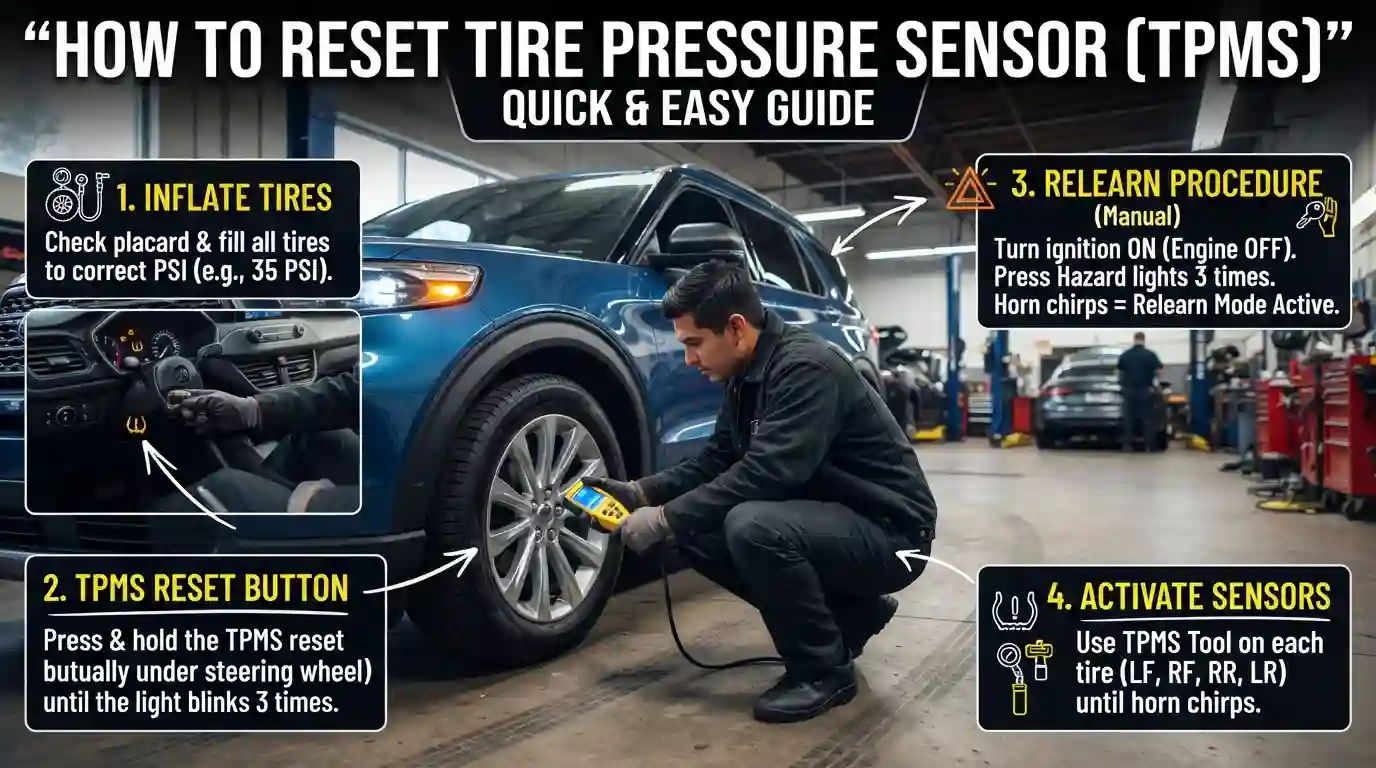
To reset a tire pressure sensor, first inflate all tires to the pressure listed on your vehicle’s driver-side door-jamb label. Then use your vehicle’s TPMS reset button, dashboard menu, automatic drive cycle, or required relearn procedure. The exact method varies by make, model, and year, so check the owner’s manual before using a specific reset procedure.
Key Takeaways
- Always check and correct tire pressure before resetting TPMS.
- Some vehicles reset automatically after you drive for a short distance.
- Others require a TPMS button, dashboard setting, or scan tool.
- A reset does not repair a damaged or dead sensor.
- A flashing TPMS light can indicate a system fault rather than simply low tire pressure.
What Does a Tire Pressure Sensor Do?
A tire pressure monitoring system, commonly called TPMS, helps warn you when tire pressure becomes too low. Depending on the vehicle, the system may use sensors inside the wheels or use wheel-speed information to detect changes in tire inflation.
When the system detects a pressure problem, you may see a symbol that looks like a tire with an exclamation point on your dashboard.
The important thing to remember is that the warning light does not tell you to simply press a reset button. It tells you to check the tires first.
If a tire is actually low, resetting the system without correcting the pressure does not solve the problem.
Before You Reset the TPMS
Check the Recommended Tire Pressure
Start with the driver’s-side door jamb. Look for the Tire and Loading Information label. It normally lists the recommended cold tire pressure for your vehicle.
Use this number instead of the maximum PSI printed on the tire’s sidewall.
Check all four tires with an accurate pressure gauge. If your vehicle monitors a spare tire, check that one too.
For the most accurate reading, check the tires when they are cold. If one tire is noticeably lower than the others, do not assume the TPMS simply needs a reset. You may have a nail, puncture, valve problem, or slow leak.
Inspect for a Leak or Damaged Tire
Look at each tire for obvious damage, such as:
- Nails or screws
- Cuts
- Cracks
- Bulges
- Uneven wear
- A visibly low tire
If one tire keeps losing pressure after you inflate it, have it inspected instead of repeatedly resetting the warning.
How to Reset Tire Pressure Sensor
There is no single reset procedure that works for every vehicle. Try the method specifically supported by your car.
Method 1: Drive the Vehicle
Some vehicles can relearn or update the TPMS automatically while you drive.
After correcting the tire pressures:
- Start the vehicle.
- Make sure all tires have the recommended pressure.
- Drive normally on a safe road.
- Continue driving for the amount of time or distance specified in your owner’s manual.
- Check if the warning light turns off.
Some vehicles may need several minutes of driving before the system receives updated information.
Do not assume that a particular speed or driving time works for every car. Manufacturers use different procedures.
For example, some vehicles may automatically update their readings during normal driving, while others require a specific relearn process before the warning disappears.
Method 2: Use the TPMS Reset Button
Some vehicles have a dedicated TPMS reset or initialization button.
The button’s location varies. It may be:
- Under the steering column
- Beneath the dashboard
- Near the driver’s knee area
- Inside the glove compartment
- In another location specified by the manufacturer
A typical procedure looks like this:
- Inflate the tires to the recommended cold pressure.
- Turn the ignition to the required position.
- Locate the TPMS reset button.
- Press or hold the button according to the owner’s manual.
- Wait for the vehicle to confirm the reset.
- Start the vehicle if required.
- Drive the vehicle to complete the process.
Do not rely on a generic button-holding procedure. Some vehicles use different sequences, and some do not have a physical TPMS reset button at all.
Method 3: Use the Dashboard or Infotainment Menu
Newer vehicles may put the TPMS reset function inside the instrument-cluster or infotainment system.
The menu may use terms such as:
- Tire Pressure
- TPMS
- Tire Pressure Monitor
- Calibrate
- Initialize
- Set Pressure
- Store Pressure
- Reset
After setting all tires to the correct pressure, open the appropriate vehicle menu and follow the on-screen instructions.
Some vehicles require the engine to be running. Others require the ignition to be on while the vehicle remains parked.
For example, certain Hyundai vehicles provide a TPMS reset procedure through the steering-wheel controls and instrument cluster after the tires have been adjusted to the recommended pressure.
Method 4: Perform a TPMS Relearn With a Tool
A vehicle may need a sensor relearn after you replace a TPMS sensor or change wheel positions.
A relearn teaches the vehicle which sensor belongs to each wheel position.
Depending on the vehicle, the process may be:
- Automatic
- Stationary
- OBD-based
A TPMS service tool can activate individual sensors and help register their IDs with the vehicle. Some systems use an OBD connection to transfer the information to the vehicle’s computer.
If your vehicle specifically requires a tool, following a generic reset procedure will not replace the relearn process.
Reset vs. Relearn: What Is the Difference?
The terms reset, calibration, and relearn are often used interchangeably, but they can describe different tasks.
A reset or calibration may tell the vehicle to use the current tire pressures as its reference.
A relearn may tell the vehicle which sensor ID belongs to each wheel.
Programming can involve configuring a replacement sensor before the vehicle can recognize it.
This difference matters after tire service. If you only adjusted air pressure, your vehicle may need a simple reset or calibration. If you installed a new sensor, the vehicle may need a full relearn or sensor programming procedure.
Why Is the TPMS Light Still On?
If the warning remains after you reset the system, check these possibilities.
The Tires Are Still Underinflated
Check every tire again with a pressure gauge.
Do not rely only on how the tires look. A tire can be significantly underinflated without looking obviously flat.
The Vehicle Needs a Relearn
If you recently rotated the tires, changed wheels, or installed a new TPMS sensor, the vehicle may need to learn the sensor positions or IDs.
In this situation, adding air may not make the warning disappear.
A TPMS Sensor May Be Faulty
A TPMS sensor can fail because of physical damage, corrosion, electronic problems, or a depleted sensor battery.
If the vehicle cannot receive information from a sensor, repeatedly resetting the system will not fix the underlying problem.
A TPMS-capable diagnostic tool can help identify which sensor or system component is causing the problem.
The TPMS Light Is Flashing
Pay close attention to the way the warning behaves.
A solid TPMS warning commonly points to a low-pressure condition. A light that flashes for a period and then stays illuminated can indicate a TPMS malfunction.
If the light repeatedly flashes and remains on, have the system inspected rather than continuing to reset it.
Do You Need a TPMS Reset Tool?
Not necessarily.
Many vehicles allow the driver to reset or initialize the system without special equipment. Others require a TPMS activation or relearn tool.
You generally do not need a professional tool simply because the TPMS light comes on after adding air. First correct the pressure and follow the vehicle’s normal reset procedure.
A specialized tool becomes more useful when you have:
- A newly installed TPMS sensor
- A replacement wheel
- A persistent warning
- Missing pressure readings
- A sensor that will not communicate
- A vehicle that requires stationary or OBD relearn
If you are unsure which procedure your vehicle requires, the owner’s manual is the best starting point.
Can You Drive With the TPMS Light On?
Do not treat the warning light as something you can safely ignore.
Check the tire pressures as soon as possible. If a tire is significantly low, inflate it to the recommended pressure before continuing normal driving.
If you notice a flat tire, severe damage, unusual vibration, pulling, or other signs of a tire problem, stop driving and have the tire inspected.
Remember that TPMS is a warning system, not a replacement for regular tire checks.
Frequently Asked Questions
How long does it take for a TPMS light to go off?
It depends on the vehicle. Some systems update shortly after you correct the pressure, while others require a drive cycle or specific reset procedure. If the light remains on after you have confirmed the correct pressure, check if your vehicle requires a TPMS calibration or sensor relearn.
Can I reset my TPMS myself?
Yes, many vehicles allow you to reset TPMS yourself. The process may involve driving, pressing a reset button, using a dashboard menu, or starting a calibration procedure. However, some vehicles require a TPMS service tool, especially after installing replacement sensors.
Do I need to reset TPMS after changing tires?
Not always. Simply replacing the rubber tire may not require the same procedure as replacing a wheel or TPMS sensor. However, tire rotation, wheel replacement, sensor replacement, or pressure adjustment can require calibration or relearning depending on the vehicle.
What does a flashing TPMS light mean?
A flashing TPMS warning light followed by a steady light can indicate a TPMS system malfunction rather than ordinary low tire pressure. Check your owner’s manual and have the system diagnosed if the warning continues.
Conclusion
Learning how to reset a tire pressure sensor is usually straightforward, but the correct procedure depends on your vehicle. Start by checking every tire and setting the pressure to the specification on the driver’s-side door-jamb label. Then use the reset button, dashboard menu, automatic drive cycle, or TPMS relearn procedure recommended for your specific vehicle.
If the warning remains after the pressure is correct, do not keep resetting the system blindly. A sensor may need to be relearned, programmed, or replaced. A flashing warning can also point to a system fault. When in doubt, use your owner’s manual or have a qualified tire or automotive technician diagnose the TPMS system.