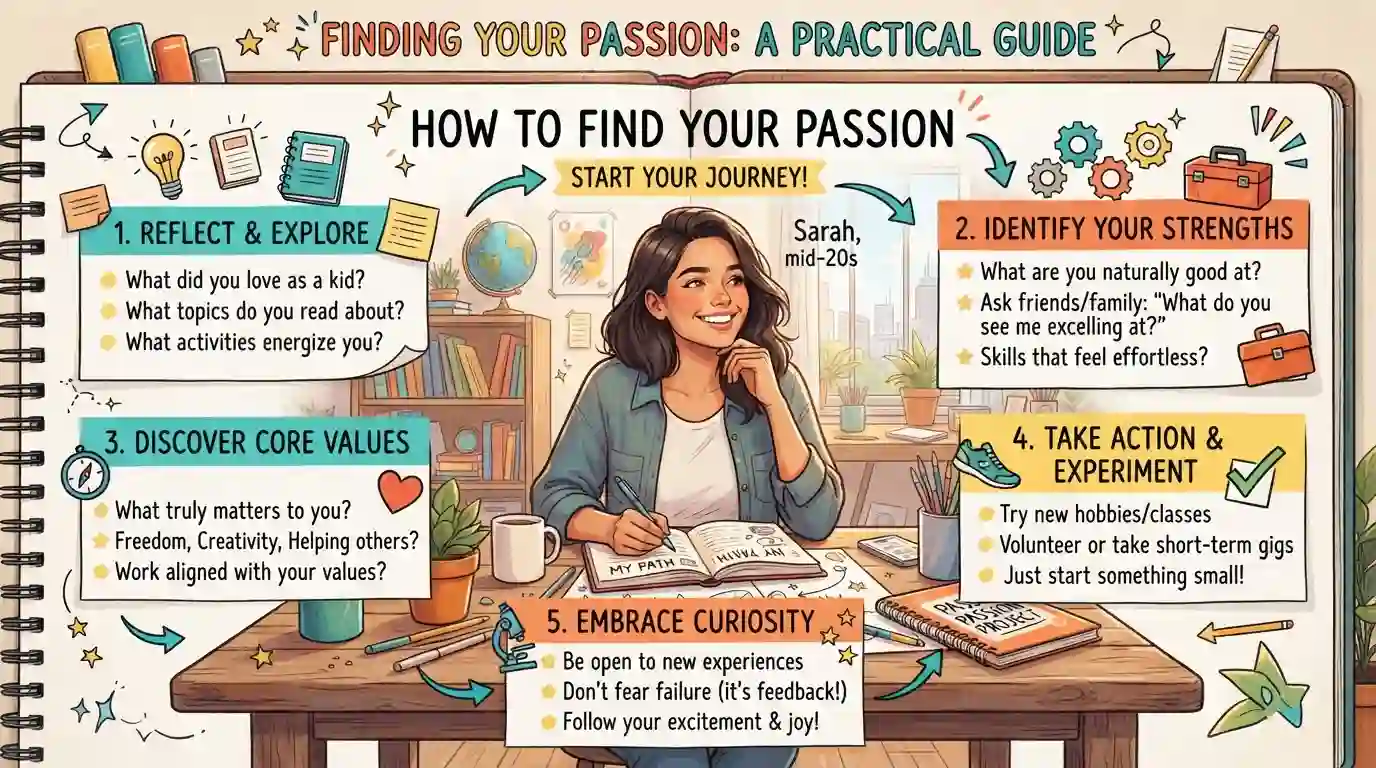
To find your passion, pay attention to the activities that make you curious, energized, fulfilled, or eager to learn. Look at your interests, strengths, values, and past experiences, then test promising ideas through small real-world experiments. Your passion may develop gradually rather than appear as one sudden discovery.
Key Takeaways
- Your passion often grows from curiosity, practice, and meaningful experiences.
- Look for patterns in what naturally interests and energizes you.
- Your passion does not have to become your career.
- Trying different activities can teach you more than overthinking your future.
- You can have several passions at different stages of life.
What Does It Mean to Find Your Passion?
Finding your passion means discovering the activities, subjects, problems, or causes that genuinely hold your interest and make you want to keep learning or participating.
For some people, passion comes from creating art. For others, it may involve teaching, technology, sports, writing, helping people, building things, cooking, nature, business, or solving difficult problems.
The important point is that passion does not have to look the same for everyone.
You also do not need to discover one perfect passion that determines the rest of your life. Your interests can change as you gain experience, meet new people, and learn more about yourself.
How to Find Your Passion in 10 Steps
1. Notice What Naturally Holds Your Attention
Start by paying attention to what you choose to do when nobody is forcing you.
What topics make you lose track of time? What videos do you watch repeatedly? What subjects do you research just because you are curious?
For example, you might notice that you constantly watch videos about photography. Maybe you enjoy learning how cameras work, comparing photos, or experimenting with editing.
That repeated curiosity is worth exploring.
2. Look at Your Best Moments
Think about the moments when you felt genuinely engaged or satisfied.
They do not have to be huge achievements. A small moment can reveal something important.
Ask yourself:
- What was I doing?
- Who was I with?
- What part of the activity did I enjoy?
- Was I creating, solving, helping, teaching, organizing, or exploring?
- Would I willingly do something similar again?
Instead of looking only for a specific job title, look for patterns in the activities themselves.
3. Identify Your Strengths
Your strengths can provide useful clues about possible passions.
Maybe people often ask you to explain complicated ideas. Perhaps you are good at organizing events, fixing problems, listening to others, designing things, writing, persuading people, or working with numbers.
Being good at something does not automatically mean you are passionate about it. However, a strength becomes especially interesting when you enjoy using it.
For example, someone might be naturally good at explaining things and also love helping classmates understand difficult subjects. Teaching could be an area worth exploring.
4. Think About What You Love Learning
Passion often involves curiosity.
Ask yourself what you enjoy learning about even when there is no test, grade, or reward.
Maybe you keep reading about psychology. Perhaps you want to understand how businesses grow. You might enjoy learning languages, studying animals, exploring history, or understanding how machines work.
You do not need to know exactly where that interest will lead. Start by learning more.
Over time, deeper knowledge can reveal if a simple curiosity is becoming a stronger interest.
5. Follow Your Curiosity
Do not wait until you feel completely certain.
If something catches your attention, follow it for a while.
Interested in photography? Take pictures for a month.
Curious about writing? Start a small blog or write short stories.
Interested in fitness? Learn about training and try different activities.
Thinking about coding? Take a beginner course and build something simple.
The goal is not to make a lifelong commitment. You are collecting information about yourself.
6. Revisit Old Interests
Think back to childhood and your teenage years.
What did you enjoy before you started worrying about grades, money, expectations, or what other people thought?
Maybe you loved drawing characters, building models, writing stories, taking things apart, playing music, or helping younger children.
You do not have to return to the exact activity. Instead, ask what it represented.
If you loved building things, perhaps you enjoyed creating and solving problems. If you loved writing stories, maybe imagination and communication mattered to you.
The underlying pattern may be more useful than the old hobby itself.
7. Try Small Experiments
This is one of the most practical ways to discover your passion.
Instead of asking, “What should I do with my life?” ask, “What can I test this week?”
Try a small experiment:
- Take a free class.
- Volunteer for a project.
- Interview someone who works in an interesting field.
- Start a personal project.
- Join a local group.
- Read a book about the subject.
- Spend two hours practicing the skill.
Small experiments reduce pressure because you are exploring rather than making a permanent decision.
8. Notice What Gives You Energy
Pay attention to how different activities make you feel before, during, and after doing them.
Some activities may leave you tired but satisfied. Others may feel easy but strangely empty.
Neither reaction automatically proves that something is or is not your passion. Still, repeated patterns can provide useful clues.
For example, you might notice that writing for an hour leaves you mentally tired but excited about your next idea. That combination could be worth investigating.
9. Ask Other People What They Notice About You
Sometimes other people see patterns that you overlook.
Ask a few people who know you well:
“What do you think I naturally enjoy?”
“What do you think I’m good at?”
“When have you seen me most excited?”
“What do I talk about a lot?”
Do not treat their answers as instructions. Use them as additional information.
If several people independently notice that you become especially enthusiastic when discussing technology, teaching, animals, or business, that pattern may deserve your attention.
10. Give Your Interests Time to Grow
You may not feel passionate about something immediately.
A new activity can feel awkward because you are still learning. After several weeks or months of practice, you may become more interested as your skills improve.
This is why it can be helpful to distinguish between initial excitement and lasting interest.
Ask yourself:
“Do I still want to learn more after the beginner’s excitement disappears?”
If the answer is yes, you may have found something worth pursuing further.
What If You Have Too Many Interests?
Having too many interests is not necessarily a problem.
You might love writing, photography, psychology, business, cooking, and travel at the same time. Instead of forcing yourself to choose one immediately, look for connections.
Perhaps you enjoy storytelling across different formats. Maybe you like creating, communicating, and understanding people.
You can also experiment with several interests before deciding which deserves more time.
Your goal is not to eliminate every option. It is to discover which interests continue to matter when you invest real time and effort in them.
What If You Feel Like You Have No Passion?
First, do not assume that something is wrong with you.
You may simply have not explored enough possibilities yet. You may also be tired, overwhelmed, focused on responsibilities, or putting too much pressure on yourself to discover one perfect answer.
Start smaller.
Instead of asking, “What is my passion?” ask:
“What am I curious about?”
“What sounds interesting?”
“What would I like to try?”
“What problem would I enjoy helping solve?”
Curiosity can be a much easier starting point than passion.
Does Your Passion Have to Become Your Career?
No.
A passion can become part of your career, but it can also remain a hobby or personal interest.
For example, someone might love photography without wanting to become a professional photographer. Another person may enjoy teaching children on weekends while working in a completely different field.
Current career guidance also emphasizes that people can pursue meaningful interests outside their paid work rather than tying every passion to a paycheck.
Before turning an interest into a career, consider if you enjoy the everyday work involved—not just the idea of the profession.
A Simple 7-Day Passion-Finding Exercise
You can start discovering your interests this week.
Day 1: Write down 10 things you enjoy or find interesting.
Day 2: List five activities that make you lose track of time.
Day 3: Write down your strongest skills.
Day 4: Choose one subject you would enjoy learning more about.
Day 5: Try a small activity related to that subject.
Day 6: Ask two people what they think you naturally enjoy or do well.
Day 7: Review your notes and circle the ideas that appear repeatedly.
Now choose one promising idea and test it for the next 30 days.
You do not need a perfect life plan. You only need a useful next experiment.
Frequently Asked Questions
How do I know if I have found my passion?
You may be moving toward a passion when an activity consistently holds your attention, makes you curious, and motivates you to improve. You may also find yourself wanting to return to it even when there is no immediate reward.
Can you have more than one passion?
Yes. People can have several meaningful interests at the same time. Your passions may also change throughout your life as your circumstances, skills, relationships, and experiences change.
Is it normal to have no passion?
Yes. You may simply need more opportunities to explore. Start with curiosity rather than demanding that every activity become a lifelong passion. Small experiments can help you discover what genuinely interests you.
Can a hobby become a passion?
Yes. A hobby can become a deeper passion as you spend more time learning, practicing, creating, and improving. However, you do not need to turn every enjoyable hobby into something serious.
Should I choose a career based on my passion?
Passion can be one factor in career decisions, but it does not have to be the only one. Consider your skills, values, financial needs, preferred lifestyle, job opportunities, and the type of daily work you actually enjoy.
Conclusion
Learning how to find your passion is less about discovering one hidden answer and more about noticing patterns, exploring possibilities, and taking action.
Pay attention to what interests you. Look at your strengths. Revisit old interests. Ask people you trust what they notice about you. Most importantly, test your ideas through small experiments.
You might discover a passion quickly, or you might develop one gradually through practice and experience.
So, instead of asking yourself, “What is my one true passion?” try asking, “What am I curious enough to explore next?”
That question can give you a place to begin and sometimes, beginning is how passion grows.

Dan Brown is a passionate relationship writer and anniversary message expert at coupleanniversary. With a deep understanding of love, marriage, and meaningful celebrations, he specializes in creating heartfelt anniversary wishes, romantic messages, and thoughtful words that help couples express their emotions perfectly.