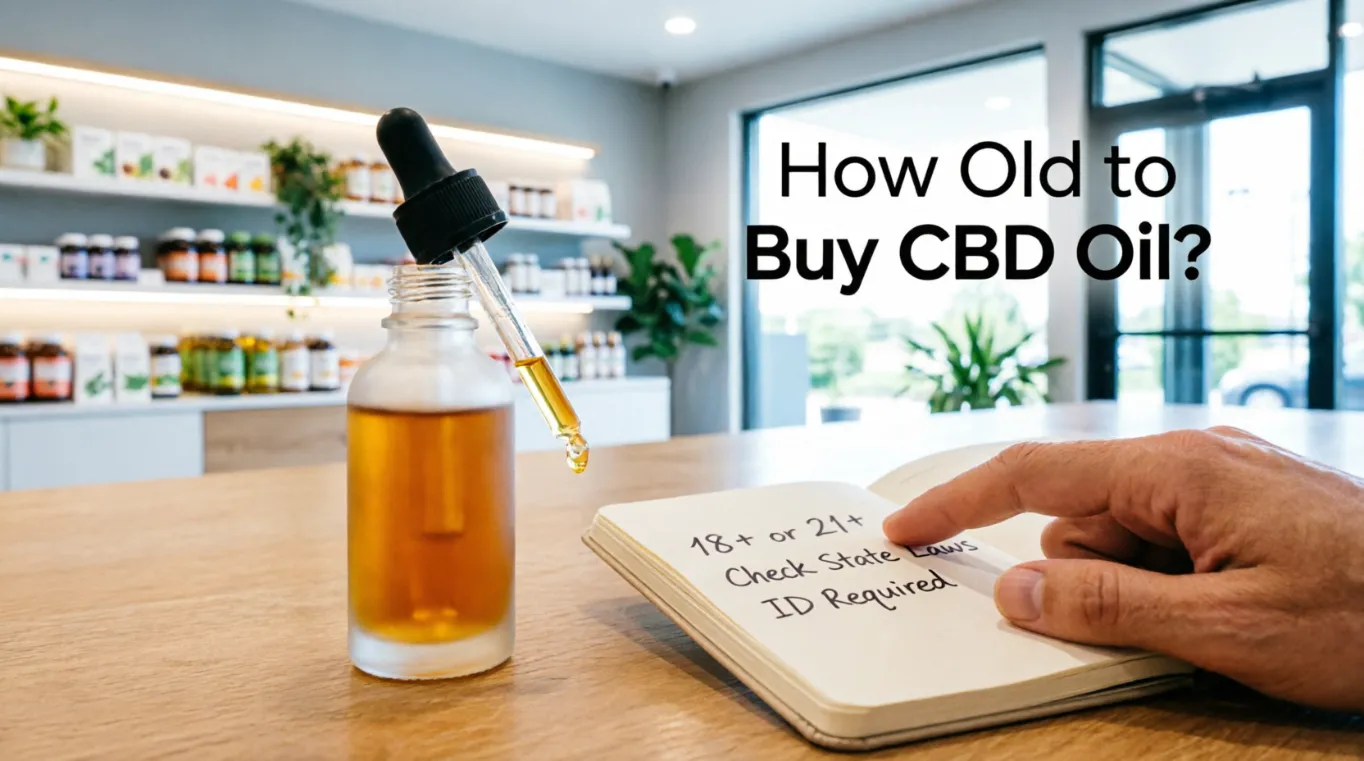
If you’ve ever stood in a wellness shop or scrolled through an online CBD store wondering if you’re actually old enough to buy, you’re not alone. Unlike alcohol or tobacco, CBD doesn’t have one clear, nationwide age law. The 2018 Farm Bill legalized hemp-derived CBD across the U.S., but it never set a minimum purchase age. Instead, individual states decide who can buy CBD and under what conditions.
The result is a patchwork of rules that can shift depending on where you live, what type of CBD product you’re buying, and if it comes from hemp or marijuana. In most places, 18 remains the standard minimum age. However, a growing number of states have pushed that number to 21, especially for edibles, drinks, and smokeable products.
Before you buy, it helps to understand exactly how these age rules work and why the answer isn’t the same everywhere.
The Federal Baseline: What the 2018 Farm Bill Actually Says
To understand CBD age laws, it helps to start with the law that made legal CBD possible in the first place: the 2018 Farm Bill. This federal legislation removed hemp, which contains no more than 0.3% THC, from the list of controlled substances. That change opened the door for hemp-derived CBD products to reach legal markets across the country.
The Farm Bill did not set any kind of minimum purchase age. Instead, it focused on THC content as the dividing line between legal hemp and illegal marijuana. Individual states then took responsibility for questions such as who can buy CBD, where retailers can sell it, and how companies should label these products.
This distinction matters because no federal law sets a national CBD purchase age equivalent to the national drinking age of 21 or the federal tobacco purchase age of 21. Instead, each state legislature can decide its own rules. That’s why age requirements can look completely different depending on which side of a state line you’re standing on.
Meanwhile, the FDA still hasn’t finalized a clear regulatory pathway for CBD in food, beverages, or supplements. Without that federal framework, states have filled the gap with their own rules. Some states enforce strict requirements, while others take a more limited approach or continue updating their regulations. This patchwork explains why the answer to “how old do you have to be to buy CBD oil” depends far more on your location than on one federal standard.
The Standard Age: 18 (Most Common Baseline)
Without a federal age law, most states have settled on 18 as the default minimum age for buying hemp-derived CBD products. This age matches the general legal standard for adulthood in the U.S., which also allows people to sign contracts, buy lottery tickets, and purchase certain over-the-counter supplements without restriction.
For products such as CBD oils, tinctures, capsules, and topical creams, 18 tends to remain the most common threshold nationwide. Lawmakers generally view these products as lower-risk options compared with items that people smoke or consume in higher concentrations. That distinction helps explain why states often apply less restrictive age standards to oils and topicals than to edibles or vape products.
It’s worth noting that a number of states don’t have an explicit CBD age law on the books at all. In those cases, the store itself often determines the purchase age. Many retailers voluntarily enforce an 18+ rule as a precaution. They may do this to limit liability and follow general marketing guidelines, even when state law doesn’t require the practice.
This means that even within “18-and-up” territory, retailers can use different enforcement methods. A gas station selling CBD oil might use a different verification process than a dedicated wellness store or an online retailer. If you’re unsure If your state has a specific law or relies on retailer discretion, check your state’s hemp program page. That source offers the most reliable way to find current information.
The Growing 21+ Trend
While 18 remains the most common baseline, a growing number of states have raised the minimum age to 21. This trend largely mirrors how many states already regulate tobacco and vaping products. Some lawmakers treat certain CBD purchases like other adult-only products and apply the same age threshold as alcohol or tobacco.
Texas provides one of the strictest examples. The state prohibits anyone under 21 from purchasing consumable hemp products, and retailers must check government-issued ID at the point of sale without exceptions. California and Connecticut have taken a similar approach for certain CBD products. They require buyers to reach 21 for products that people eat or drink, while other CBD categories may follow different age rules.
Louisiana offers another clear example of this trend. Starting January 1, 2025, the state raised its minimum purchase age for CBD and THC products from 18 to 21. The change did not include a grandfather clause for people who previously qualified under the former law. Lawmakers framed the change as an effort to bring hemp and THC products in line with alcohol regulations, prioritizing caution over convenience.
This pattern suggests that states may continue changing their CBD rules in the coming years, particularly as CBD and hemp-derived THC products become more visible on store shelves. Regulators continue to examine how companies market these products to younger consumers. If you’re buying CBD in a state that hasn’t updated its laws recently, check the current rules again. Hemp regulation continues to change quickly.
Product Type Changes the Rules
One of the most overlooked aspects of CBD age laws involves the type of product you’re buying. Many states apply different age thresholds to different product categories. As a result, the same person could qualify to buy one type of CBD product but not another, even within the same store.
Smokeable CBD products, including CBD flower, pre-rolls, and vape cartridges, often follow a stricter 21+ standard. Some states maintain this rule even when they allow adults 18 and older to purchase other CBD products. Lawmakers often treat inhalable products more like tobacco because people consume them through a similar method and regulators have raised related health concerns.
Edible and drinkable CBD products, such as gummies, beverages, and infused snacks, also increasingly fall under the 21+ threshold in states such as Texas, California, and Connecticut. Regulators often point to the resemblance between CBD edibles and everyday snack foods or drinks when explaining tighter controls. They also express concern that younger consumers could mistake or find these products appealing.
By contrast, CBD oils, tinctures, and topical creams often remain in the more lenient 18+ category. Lawmakers and regulators generally view these products as wellness or skincare items. That classification helps explain why they have not attracted the same level of regulatory attention as smokeable and edible products.
Hemp-Derived vs. Marijuana-Derived CBD: A Critical Distinction
Not all CBD follows the same legal rules. One of the biggest sources of confusion involves where the CBD comes from. Hemp-derived CBD and marijuana-derived CBD fall into separate legal categories, with different rules governing who can buy them.
Hemp-derived CBD, the type that the 2018 Farm Bill legalized, contains no more than 0.3% THC. Consumers can find these products in stores, online, and even at some gas stations. State laws commonly set the 18+ or 21+ requirements discussed earlier for this category. This is also the version many shoppers encounter when they look for everyday CBD oils, tinctures, or topicals.
Marijuana-derived CBD follows a different path. In states with legal recreational cannabis, licensed dispensaries sell marijuana-derived CBD products, and they generally restrict purchases to adults 21 and older. These products can contain significantly higher THC levels than hemp-derived CBD, which helps explain the different regulatory approach.
Many states also provide a medical exception. In those states, patients as young as 18 may qualify to purchase marijuana-derived CBD products if they meet the state’s medical requirements and have a doctor’s recommendation. The rules vary by state, even when the recreational purchase age remains 21.
This distinction matters most for online shoppers. A product labeled simply as “CBD” doesn’t always tell you if the product comes from hemp or marijuana. Check the source and THC content before assuming which age rule applies.
State-by-State Snapshot
Because individual states set CBD age laws rather than the federal government, it helps to think of the U.S. as falling into three general categories. Specific rules can still change as state legislatures revisit their hemp laws.
18+ States
18+ states make up the majority. These states generally apply a standard adult purchase age to hemp-derived CBD oils, tinctures, and topicals. They may not require the stricter ID verification procedures that some other states use. In many cases, individual retailers play a larger role in enforcement than detailed statutory language.
21+ States
21+ states represent the fastest-growing category. Texas stands out as one of the strictest examples. The state bans the sale of consumable hemp products to anyone under 21 and requires retailers to check government-issued ID at checkout.
California and Connecticut use a similar 21+ standard for certain edible and drinkable CBD products. Louisiana joined this group in January 2025 when it raised its minimum age from 18 to 21.
States With Unsettled or Evolving Frameworks
States with unsettled or evolving frameworks round out the picture. Ohio and Pennsylvania provide examples of states where hemp and CBD regulations have involved sunset clauses, stalled legislation, or changing alignment with federal standards. These developments can create a less predictable legal landscape for consumers.
Because state laws can change from one legislative session to the next, don’t treat any state-by-state summary as a permanent reference. Check your state’s current hemp program guidance before buying CBD.
How Retailers Enforce Age Limits
Even when state law establishes a clear minimum age, retailers often determine how they enforce that requirement. Over the past few years, more retailers have started using ID checks for CBD purchases, particularly in states that have raised their age requirements to 21.
In physical stores, the process often resembles an alcohol or tobacco purchase. A cashier requests a government-issued ID, checks the birth date, and refuses the sale if the customer doesn’t meet the minimum age. In Texas, for example, retailers must verify age at the point of sale for consumable hemp products. Retailers that fail to follow the requirement can face penalties.
Online retailers face a different enforcement challenge. Some sites still rely on simple self-attestation, where customers check a box confirming that they meet the legal age before completing a purchase. Increasingly, however, more retailers use formal age-verification services. These services may require buyers to upload an ID or confirm their birth date through a third-party verification tool before the retailer processes an order, particularly when shipping to states with stricter requirements.
This growing focus on enforcement goes beyond basic compliance. Retailers also face liability risks if they sell restricted products to minors. That risk gives stores a strong incentive to verify customer ages carefully, even when their state’s law remains unclear or continues to evolve.
Why There’s No Federal Standard
For a product as widely available as CBD, it might seem surprising that no federal age requirement governs every purchase. Part of the reason involves the FDA, which has yet to finalize a clear regulatory pathway for CBD in food, beverages, or dietary supplements. Without that framework, the agency has largely left broader consumer protection questions, including purchase age, to individual states.
Some groups have called for Congress to create a more uniform national standard, similar to the federal approach for alcohol and tobacco purchases. Other groups question if hemp-derived CBD needs the same restrictions because it does not produce the same intoxicating effects as THC-heavy products. These different positions have contributed to the slow development of a single federal standard.
If Congress eventually introduces a federal standard, some industry observers expect lawmakers to follow the alcohol and tobacco precedent and set a national minimum age of 21. However, that remains a potential future development rather than a current nationwide CBD age requirement.
Until then, responsibility for determining who can legally buy CBD and at what age remains divided among the fifty state legislatures. Each state can move at its own pace and establish its own requirements.
How to Check the Law in Your State Before Buying
Given how quickly CBD age laws have shifted, relying on outdated information or a general assumption can create problems. Louisiana, for example, raised its minimum age as recently as 2025. The most reliable way to confirm the current rule where you live involves checking official state sources rather than relying only on secondhand summaries.
Start with your state’s department of agriculture. State hemp programs often operate through agriculture departments, which frequently publish information about purchase age, licensing, and labeling requirements for CBD retailers. Many states also maintain dedicated hemp program pages that they update when new legislation takes effect.
If you can’t find clear guidance through your agriculture department, check your state legislature’s website. Search for recently passed bills related to “hemp,” “CBD,” or “consumable hemp products.” These records can show if your state recently changed its age requirement, added product-specific rules, or introduced ID verification requirements.
You should also check if your state distinguishes between hemp-derived and marijuana-derived CBD. These products often fall under different regulatory bodies, such as state hemp programs versus cannabis or marijuana control boards. That distinction can affect not only the minimum age but also where you can legally buy the product.
Because hemp regulation changes quickly, treat any article, including this one, as a starting point rather than a permanent legal reference.
Common Misconceptions
With CBD laws varying so much by state and product type, several misconceptions have become common. Clearing them up can help you avoid confusion or an awkward moment at checkout.
“CBD is unregulated, so anyone can buy it.”
This isn’t accurate in most states. While CBD doesn’t face the same federal restrictions as marijuana, most states have some form of age requirement, if through explicit statutes or standard retailer policies.
“If it’s hemp-derived, it’s always legal to buy at 18.”
This assumption doesn’t hold up in states such as Texas, California, and Connecticut. Certain hemp-derived products, particularly edibles, drinks, and smokeables, can require buyers to reach 21 regardless of their low THC content.
“Online purchases don’t check age.”
That statement applied more often a few years ago than it does today. As more states tighten their hemp laws, online retailers have increasingly adopted formal age-verification tools, especially when they ship products to states with stricter 21+ requirements.
“CBD and marijuana products follow the same age rules.”
In states with legal recreational cannabis, marijuana-derived CBD follows different rules from hemp-derived CBD. Licensed dispensaries generally sell marijuana-derived products to customers 21 and older, while general retailers may sell hemp-derived CBD under different state requirements.
“Once I know my state’s law, it won’t change.”
State hemp laws can change quickly. Louisiana’s recent move from 18 to 21 shows why consumers should periodically check current requirements instead of assuming that today’s rules will remain the same.
Conclusion
So, how old do you have to be to buy CBD oil? The honest answer depends on your state, the type of product, and If the CBD comes from hemp or marijuana. No federal law currently sets one nationwide CBD purchase age, so the rules can look completely different depending on where you live.
Eighteen remains the most common baseline for hemp-derived oils, tinctures, and topicals, while a growing number of states have raised the minimum age to 21 for certain products, particularly edibles, drinks, and smokeable CBD.
Because this area of law continues to change, as Louisiana’s shift from 18 to 21 demonstrates, check your state’s current hemp regulations before making a purchase. When in doubt, visit your state’s agriculture department or hemp program page for the latest information.