Betrayal doesn’t just hurt in the moment it changes how you move through every relationship that comes after. If it was a partner who lied, a friend who talked behind your back, or a colleague who broke your confidence, the aftermath often lingers far longer than the incident itself. You find yourself scanning for red flags, questioning your own judgment, or bracing for disappointment before it even arrives. This is what makes rebuilding trust after betrayal so difficult: it’s not just about forgiving someone else, it’s about repairing your own sense of safety in connection.
Learning how to trust again after betrayal isn’t a switch you flip or a deadline you hit. It’s a gradual, deliberate process, one built in layers, tested through small moments, and guided by your own pace rather than anyone else’s timeline. This article walks through why betrayal affects us so deeply, and what genuine, sustainable trust-rebuilding actually looks like.
Understanding Betrayal Trauma
Before you can rebuild trust, it helps to understand what betrayal actually does to you psychologically and physically. This isn’t just heartbreak; it’s a distinct kind of injury with its own patterns and its own recovery process.
What Counts as Betrayal
Betrayal isn’t limited to infidelity, though that’s often the first thing people think of. It can show up as a friend sharing something you told them in confidence, a family member choosing loyalty to someone else over you, a business partner cutting corners behind your back, or a colleague taking credit for your work. What unites all of these is a broken expectation: someone you relied on to act in your interest acted against it instead.
The Psychology Behind the Pain
When trust breaks, your brain treats it the way it treats any threat because, in a sense, it is one. Trust is what allows you to lower your guard around another person; when that assumption is violated, your nervous system responds with heightened alertness. This is often called hypervigilance: the tendency to scan for warning signs, replay past interactions, and anticipate betrayal before it happens. It’s an evolved protective mechanism, not evidence that something is wrong with you.
Researchers who study betrayal trauma note that the closer the relationship, the deeper the wound betrayal by someone we depended on for safety or care (a parent, partner, or close friend) tends to cut more deeply than betrayal by a stranger or acquaintance, precisely because the relationship itself was part of what made us feel secure.
Why It Spreads Beyond the Original Relationship
One of the most disorienting parts of betrayal trauma is how it generalizes. A betrayal by one person can quietly rewrite your assumptions about people as a whole. You might find yourself distrusting a new partner who’s done nothing wrong, or doubting a coworker’s intentions with no real evidence not because you’re being unreasonable, but because your brain is trying to prevent the original pain from happening again.
Common Myths That Get in the Way of Healing
A few unhelpful narratives tend to surface after betrayal, and they’re worth naming directly:
- “Time heals all wounds.” Time alone doesn’t heal betrayal trauma, what heals it is what you do with that time: processing, reflecting, and slowly testing trust again.
- “Just let it go.” Suppressing the hurt in the name of moving on tends to bury it rather than resolve it, and buried pain often resurfaces later, sometimes in unrelated relationships.
- “You’re too sensitive.” Hypervigilance and caution after betrayal are protective responses, not overreactions or character flaws.
Reframing Betrayal as an Injury, Not a Failure
Perhaps the most important shift is this: struggling to trust again after betrayal is not proof that you’re broken, needy, or bad at relationships. It’s a normal response to a real injury. Just as a physical wound needs time and care to heal, betrayal, trauma needs space, patience, and the right conditions to recover which is exactly what the rest of this article will walk through.
The Emotional Aftermath
Once the initial shock of betrayal settles, what follows is often a complicated, non-linear emotional process. Understanding what’s normal here can help you stop judging yourself for not “getting over it” as quickly as you think you should.
The Stages People Often Move Through
Many people experience something similar to a grief process after betrayal, shock, denial, anger, bargaining, sadness, and eventually acceptance. It’s worth stressing that these stages are not a checklist to move through in order. You might feel angry, then calm, then blindsided by grief again weeks later. Healing from betrayal tends to loop rather than progress in a straight line, and that looping is normal, not a sign you’re doing it wrong.
Common Symptoms of Betrayal Trauma
The emotional aftermath often shows up in ways that don’t feel purely emotional at all:
- Intrusive thoughts replaying the betrayal or imagining confrontations that never happened
- Rumination circling the same questions (“why didn’t I see it?” “was any of it real?”) without resolution
- Sleep disruption racing thoughts at night, difficulty falling or staying asleep
- Anxiety in new situations feeling on edge in relationships that have given you no reason for concern
- Physical tension a heightened startle response, stomach issues, or fatigue tied to prolonged stress
Self-Blame and Shame
One of the more corrosive parts of betrayal is how easily it turns inward. Many people ask themselves, “How did I not see this coming?” or “What does this say about my judgment?” This self-blame can be even more damaging than the original betrayal, because it doesn’t just question the other person, it questions your own perception of reality. It’s worth remembering: being deceived is a reflection of the other person’s choices, not proof of your own poor judgment.
The Hidden Cost: Loss of Self-Trust
Betrayal doesn’t only damage your trust in others it often damages your trust in yourself. If someone hid the truth well, second-guessing your own instincts can feel like the safer option going forward. But over-correcting into constant self-doubt makes it harder to recognize genuine trustworthiness later, since you’re no longer confident in your own read of people.
When It’s More Than “Normal” Pain
For most people, these symptoms ease gradually with time, support, and the strategies covered later in this article. But sometimes betrayal trauma symptoms are more persistent or severe including panic responses, depression, or an inability to function in daily life. Signs it may be time to seek professional support include:
- Symptoms that don’t ease after several months
- Difficulty functioning at work or in daily routines
- Persistent intrusive thoughts or flashbacks to the betrayal
- New or worsening anxiety, depression, or panic symptoms
- A pattern of betrayal across multiple relationships that feels impossible to make sense of alone
There’s no “bad enough” threshold required to seek help if the aftermath is affecting your quality of life, that’s reason enough.
Why We Struggle to Trust Again
Understanding why trust is so hard to rebuild, not just accepting that it is, makes the process feel less like a personal shortcoming and more like a pattern you can actually work with.
Overgeneralization: “This Person Lied, So Everyone Lies”
One of the most common (and most limiting) responses to betrayal is turning a specific experience into a universal rule. Your brain, trying to protect you from future pain, takes the lesson “this person wasn’t trustworthy” and quietly expands it to “people aren’t trustworthy.” This feels protective in the short term, but it also closes the door on relationships that never gave you a reason for suspicion. The generalization isn’t a conscious choice, it’s a byproduct of a threat-detection system trying to keep you safe as efficiently as possible, even at the cost of accuracy.
Hypervigilance and Testing Behaviors
After betrayal, many people develop a heightened radar for warning signs, sometimes to the point of manufacturing tests to “prove” if someone is trustworthy. This might look like:
- Reading into neutral texts or delayed replies as signs of dishonesty
- Checking up on a partner’s whereabouts or communications
- Asking indirect questions to “catch” someone in a lie
- Withholding information to see if the other person notices or reacts
These behaviors are understandable attempts to regain a sense of control, but they often backfire either by damaging a genuinely trustworthy relationship through constant suspicion, or by reinforcing anxiety when the “tests” don’t fully resolve the underlying fear.
Self-Protection Through Avoidance or Emotional Walls
Another common response is simply avoiding vulnerability altogether, staying emotionally guarded, keeping people at arm’s length, or avoiding new relationships entirely. This can feel like the safest option because it removes the risk of being hurt again. The tradeoff, though, is that it also removes the possibility of connection, support, and intimacy the very things most people need in order to heal.
The Paradox at the Center of Betrayal Recovery
Here’s the difficult truth many people run into: the people most affected by betrayal often need connection the most, precisely at the moment they’re least equipped to risk it. Isolation feels protective, but prolonged isolation can deepen the very distrust and loneliness betrayal already created. This paradox is exactly why trust-rebuilding can’t be about eliminating risk entirely; it has to be about learning to take smaller, calculated risks again, which is what the next section covers in depth.
Core Principles of Rebuilding Trust
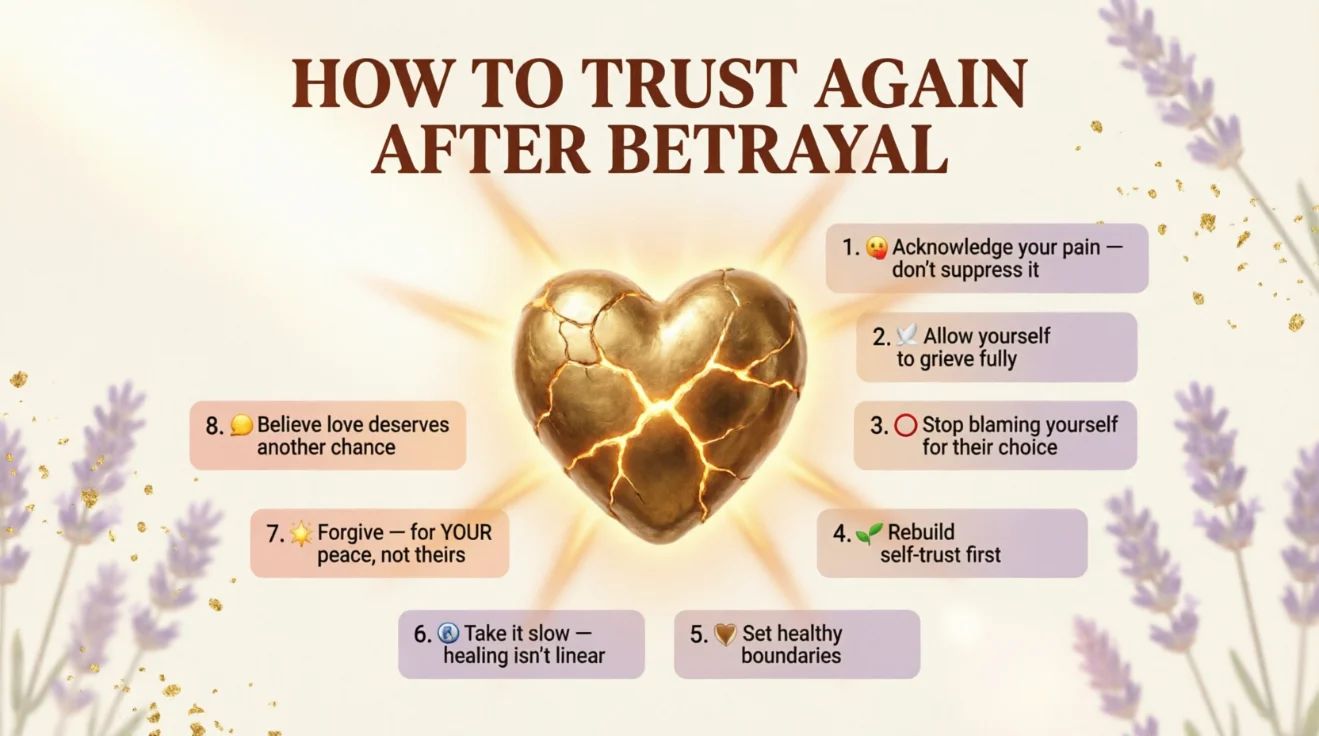
These seven principles form the foundation of trust-rebuilding. They’re not a strict sequence; you may move through them in a different order, revisit some more than once, or work on several simultaneously.
1. Feel It Before You Try to Fix It
It’s tempting to rush toward “moving on,” especially if people around you seem impatient for you to feel normal again. But skipping the anger, grief, or confusion tends to bury those feelings rather than resolve them and buried feelings have a way of resurfacing at the worst moments, often in a completely different relationship. Journaling, talking with a trusted friend, or working with a therapist can help you process what happened rather than suppress it.
2. Separate the Person From the Pattern
Betrayal often gets generalized into a blanket belief: this person lied, so people lie. Get specific instead. Ask yourself:
- What exactly did this person do?
- Was this a pattern of theirs, or a one-time failure?
- What does this actually tell me about people in general versus about them specifically?
This isn’t about excusing what happened. It’s about keeping the lesson accurate, so it doesn’t quietly cost you relationships that never earned your suspicion.
3. Rebuild Trust in Layers, Not All at Once
Trust isn’t binary. Think of it as a dimmer switch rather than an on/off button you extend a small amount and observe how it’s handled before extending more. In practice, this might mean:
- Sharing something low-stakes with a new friend before sharing something vulnerable
- Giving a partner a chance to follow through on a small promise before relying on a bigger one
- Noticing how someone responds when you set a boundary, rather than assuming the worst upfront
Each honored moment becomes evidence your nervous system can actually use not just a hopeful thought.
4. Prioritize Actions Over Words
After betrayal, words can feel cheap often because the betrayal itself came wrapped in reassuring words. Consistency over time is what actually rebuilds credibility. Watch for:
- If actions match what’s said
- If someone is patient with your caution, or pressures you to “just get over it”
- If they take responsibility, or minimize and deflect
5. Rebuild Self-Trust Alongside Trust in Others
Betrayal often damages your confidence in your own judgment as much as your trust in others. Rebuilding self-trust means recognizing that you made the best decision you could with the information available at the time being deceived reflects the other person’s choices, not a verdict on your perception. As you practice noticing red flags and listening to your instincts again, self-trust tends to return alongside trust in others.
6. Set Boundaries Instead of Walls
A wall keeps everyone out indiscriminately; a boundary lets you decide, case by case, what you’re comfortable sharing or risking and it can flex as trust is earned. Boundaries might sound like:
- “I need us to check in more often while I rebuild trust in this relationship.”
- “I’m not ready to talk about that yet, but I might be later.”
- “I need consistency over the next few months, not just an apology.”
7. Accept That Some Uncertainty Is Permanent
Full certainty was never actually available even before the betrayal. Trust always involves some risk; that’s what makes it trust rather than proof. Healing doesn’t mean returning to a naive, risk-free version of trust. It means becoming willing to take reasonable risks again, with better judgment about who’s earned them.
Rebuilding Trust in Specific Contexts
The general principles above apply everywhere, but how they play out shifts depending on who betrayed you and what kind of relationship you’re rebuilding. Here’s how trust-rebuilding looks across common contexts.
Romantic Relationships
Romantic betrayal, infidelity, broken promises, financial dishonesty tends to hit hardest because it threatens the core assumption the relationship was built on. There’s an important distinction here:
- Rebuilding trust with the same partner requires their active participation: transparency, accountability, and consistent follow-through over an extended period. Trust can’t be rebuilt unilaterally when the other person is still in the picture.
- Trusting a new partner after a past relationship ended in betrayal is a different challenge. You’re not rebuilding trust with the person who hurt you, you’re rebuilding your general capacity to trust despite them. This often means consciously separating your new partner’s actions from your ex’s, rather than testing the new relationship against old wounds.
Friendships
Betrayal by a friend gossiping, breaking a confidence, taking sides against you can be uniquely disorienting because friendships often lack the built-in structures (couples counseling, family obligation) that prompt repair conversations. Rebuilding trust in a friendship usually requires an honest conversation about what happened, rather than letting the relationship quietly fade or continuing as if nothing occurred.
Family
Family betrayal carries its own weight because you often can’t simply exit the relationship the way you might a friendship or romantic partnership. Holidays, shared history, and other family members can make full separation impractical or undesired. Here, trust-rebuilding may look less like full closeness and more like recalibrated expectations deciding what level of openness feels safe, and accepting that the relationship might operate differently going forward, even if it continues.
Workplace
Professional betrayal, a colleague taking credit, a manager breaking a promise, being excluded from decisions that affect you can erode trust in an environment you can’t always leave immediately. Rebuilding trust at work often centers on documentation, clearer boundaries around what you share informally, and recalibrating how much you rely on verbal assurances versus written agreements.
Trusting New People in General
Sometimes betrayal doesn’t just damage trust in one relationship it damages your baseline trust in people generally. This is especially common after repeated betrayals or a particularly severe one. In this case, the work isn’t about repairing a specific relationship; it’s about consciously rebuilding your general capacity for trust, often starting with lower-stakes relationships (acquaintances, casual friends) before extending that trust to more vulnerable, high-stakes ones.
Practical Tools and Exercises
Understanding the principles behind trust-rebuilding is one thing; actually practicing it day to day is another. These are concrete tools you can use as you work through the process.
Journaling Prompts to Process Betrayal
Writing can help externalize thoughts that otherwise loop endlessly in your head. Useful prompts include:
- What exactly happened, in as much factual detail as I can manage?
- What did I believe before this happened that I no longer believe?
- What feelings am I avoiding sitting with right now?
- What would I need to see to feel safer in a relationship again?
“Evidence Tracking” for Small Trust-Affirming Moments
Because betrayal recovery often runs on emotion rather than fact, it helps to keep a running record of moments where someone (a new person, or the person you’re rebuilding trust with) followed through, told the truth, or respected a boundary. Over time, this log becomes tangible evidence your nervous system can reference countering the instinct to assume the worst by default.
Boundary-Setting Scripts
Having language ready in advance makes boundaries easier to hold in the moment. A few examples:
- “I need to know about this kind of thing sooner next time, not after the fact.”
- “I’m willing to keep talking, but I need us to slow down.”
- “I can’t promise I’ll be fully comfortable yet, but I’m willing to try this.”
Communicating Your Needs During the Repair Process
If you’re rebuilding trust with someone specific, naming your needs explicitly rather than expecting them to guess reduces the guesswork on both sides. This might mean saying directly: “I need consistency over time, not just reassurance,” or “I need you to be okay with me asking questions without getting defensive.”
Grounding Techniques for Triggered Hypervigilance
When old fears flare up a delayed text, an unexplained absence grounding techniques can help you respond rather than react:
- Pause and name what you’re feeling before acting on it (“I’m feeling anxious, not necessarily in danger”)
- Ask if the current situation actually resembles the original betrayal, or just feels similar
- Use a brief physical reset deep breathing, a short walk before deciding how to respond
Questions to Ask Before Extending Trust Further
Before taking the next step in trusting someone, it can help to check in with yourself:
- Is this decision based on their actual behavior, or on hope?
- What’s the smallest version of trust I could extend here to test the waters?
- Am I setting a boundary, or building a wall?
Rebuilding Trust With the Person Who Betrayed You
If the goal is repairing a relationship with the specific person who broke your trust rather than rebuilding your general capacity to trust, the process depends heavily on what they bring to it. Trust can’t be rebuilt unilaterally; it requires real participation from both sides.
Signs the Other Person Is Genuinely Accountable
Real accountability looks different from a one-time apology. Watch for if the person:
- Takes full ownership of what they did, without minimizing or shifting blame onto you or circumstances
- Answers questions about what happened honestly, even when it’s uncomfortable
- Doesn’t rush your timeline or pressure you to “just move on”
- Follows through consistently, not just in the days immediately after being caught or confronted
What Real Repair Looks Like
Genuine repair tends to involve three ongoing elements, not a single gesture:
- Transparency being more open than before, especially in the areas where trust was broken (sharing passwords, whereabouts, or information proactively, for example, rather than only when asked)
- Patience accepting that your caution, questions, or need for reassurance may continue for longer than they’d like, without treating that as a punishment they don’t deserve
- Consistency over time repair isn’t proven in weeks; it’s proven in months of aligned words and actions, especially when no one is watching
Red Flags That Repair Isn’t Happening
Some signs suggest the relationship may not be moving toward genuine repair:
- Defensiveness or anger when you ask reasonable questions
- Framing your hurt as something you need to “get over” on their schedule
- Repeated minor betrayals or boundary violations after the initial one
- Using guilt or blame-shifting (“you’re making me feel like a bad person”) instead of accountability
- Change that only lasts as long as they’re worried about consequences
When Reconciliation Isn’t the Right Goal
Not every relationship is meant to be rebuilt and that’s a legitimate outcome, not a failure. If the other person isn’t willing to be accountable, or if the betrayal reflects a deeper pattern rather than a single lapse, choosing to let go of the relationship (rather than forcing trust that isn’t earned) can be the healthier path. Trust-rebuilding, in this case, becomes about your capacity to trust others going forward, not about restoring this particular relationship.
Common Pitfalls in the Trust-Rebuilding Process
Even with good intentions, trust-rebuilding can go sideways in predictable ways. Recognizing these patterns early can help you course-correct before they undo progress you’ve already made.
Rushing the Timeline
If the pressure comes from yourself or from someone else’s impatience, moving faster than you’re actually ready for tends to backfire. Trust extended before it’s genuinely felt isn’t real trust; it’s often forced compliance that quietly builds resentment or anxiety underneath the surface.
Testing Behavior That Becomes Self-Sabotaging
Setting up “tests” to catch someone in a lie, or manufacturing scenarios to see how they react, can feel like due diligence. In practice, it often erodes the very relationship you’re trying to protect either by pushing away someone genuinely trustworthy who feels perpetually suspected, or by reinforcing your own anxiety when a test doesn’t fully resolve your fear (because no single test really can).
Confusing Vigilance With Intuition
Not every uneasy feeling after betrayal is a reliable signal. Some of it is genuine intuition, a real read on a real situation. But some of it is simply hypervigilance left over from the original wound, firing in response to something that resembles the past but isn’t actually a repeat of it. Learning to tell these apart takes practice, and misreading one for the other in either direction can cause real harm either dismissing a legitimate red flag, or treating an innocent situation as a threat.
All-or-Nothing Thinking About Trust
Believing you must either trust someone completely or not at all skips over the layered, incremental nature of real trust-building. This binary thinking often leads to either premature full trust (setting yourself up for another blow) or permanent guardedness (closing off connection entirely). Trust exists on a spectrum, and treating it that way is part of what makes rebuilding it sustainable.
Isolating Instead of Setting Healthy Boundaries
There’s a meaningful difference between protecting yourself and shutting everyone out. Isolation can feel safer in the short term, but it also removes the very connection and support that helps people heal from betrayal in the first place. Boundaries let you stay open to connection while still protecting your wellbeing; isolation forecloses connection altogether.
When to Seek Professional Support
Most people can work through betrayal with time, self-reflection, and support from people they trust but sometimes the injury runs deeper than what self-guided healing can address. There’s no shame in seeking help, and no threshold of severity required to justify it.
Signs Betrayal Trauma Is Affecting Daily Functioning
Consider reaching out to a professional if you notice:
- Symptoms that haven’t eased significantly after several months
- Difficulty concentrating at work, or a noticeable drop in performance
- Persistent intrusive thoughts, flashbacks, or an inability to stop replaying the betrayal
- New or worsening anxiety, depression, or panic symptoms
- Using avoidance, substances, or other coping mechanisms to numb the pain rather than process it
- A pattern of betrayal across multiple relationships that feels confusing or impossible to make sense of alone
- Struggling to function in basic daily routines sleep, eating, social interaction
Types of Support Available
Different situations call for different kinds of help:
- Individual therapy especially useful for processing the emotional aftermath, addressing self-blame, and rebuilding self-trust independent of any specific relationship
- Couples or relationship counseling helpful when both people are trying to repair a specific relationship (romantic or otherwise) and need a structured, neutral space to do it
- Trauma-informed therapists particularly valuable when betrayal trauma symptoms resemble broader trauma responses (hypervigilance, flashbacks, dissociation), or when the betrayal echoes earlier experiences of being harmed by someone trusted
- Support groups connecting with others who’ve experienced similar betrayals can reduce the isolation and self-blame that often accompany it
What Therapy for Betrayal Trauma Typically Addresses
A therapist working with betrayal trauma will often help you:
- Process the emotional impact of the betrayal itself, separate from any decision about the relationship’s future
- Identify and work through overgeneralized beliefs about trust and safety
- Rebuild self-trust and confidence in your own judgment
- Develop healthier boundary-setting skills
- Distinguish between genuine intuition and hypervigilance
- Decide, with support rather than in isolation, if and how to move forward with the relationship in question
Seeking support isn’t a sign that you’re handling betrayal “wrong” , it’s often what allows people to move through the process more fully, rather than getting stuck in it indefinitely.
Reframing Trust Going Forward
One of the most freeing realizations in trust-rebuilding is this: certainty was never actually on the table, even before the betrayal. Trust has always involved risk, that’s precisely what separates it from proof. No amount of vigilance, testing, or evidence-gathering can eliminate that risk entirely, because trust, by definition, means acting without full guarantees.
This means the goal of healing isn’t returning to some pre-betrayal state of naive, risk-free confidence in others. That version of trust wasn’t actually safer; it just felt that way because you hadn’t yet been hurt. Real, healthy trust looks different: it’s informed rather than blind, built on evidence and consistency rather than assumption, and extended deliberately rather than automatically.
Seen this way, rebuilding trust after betrayal isn’t a step backward to “how things used to be.” It can actually represent forward progress, a more mature, more discerning way of relating to people than you had before. You’re no longer trusting on autopilot; you’re trusting because someone has actually earned it, layer by layer.
There’s also a quieter kind of strength in this. Trust that has survived being broken and deliberately rebuilt often carries more resilience than trust that was never tested at all, simply because it was built with open eyes. You now know what warning signs to watch for, what boundaries protect you, and what genuine accountability looks like in practice.
Trust, going forward, isn’t about eliminating risk, it’s about taking smarter, more calibrated risks, with a clearer sense of who deserves them.
Conclusion
Betrayal changes something fundamental in how you relate to people but it doesn’t have to change it permanently, or for the worse. Rebuilding trust after betrayal is rarely a straight line. It moves in layers, stalls and restarts, and looks different depending on if you’re repairing a specific relationship or rebuilding your general capacity to connect with others at all.
What matters most is that the process stays yours. Not your partner’s timeline, not your family’s expectations, not some arbitrary sense of how long healing “should” take. Real trust-rebuilding happens through small, honored moments, a promise kept, a boundary respected, a hard conversation handled with honesty rather than defensiveness. Each one becomes evidence, slowly outweighing the fear that betrayal left behind.
Along the way, it’s worth remembering that you’re not just rebuilding trust in others, you’re rebuilding trust in your own judgment, your own instincts, and your own ability to tell the difference between genuine safety and old, unresolved fear. That part of the work is just as important, even if it gets less attention.