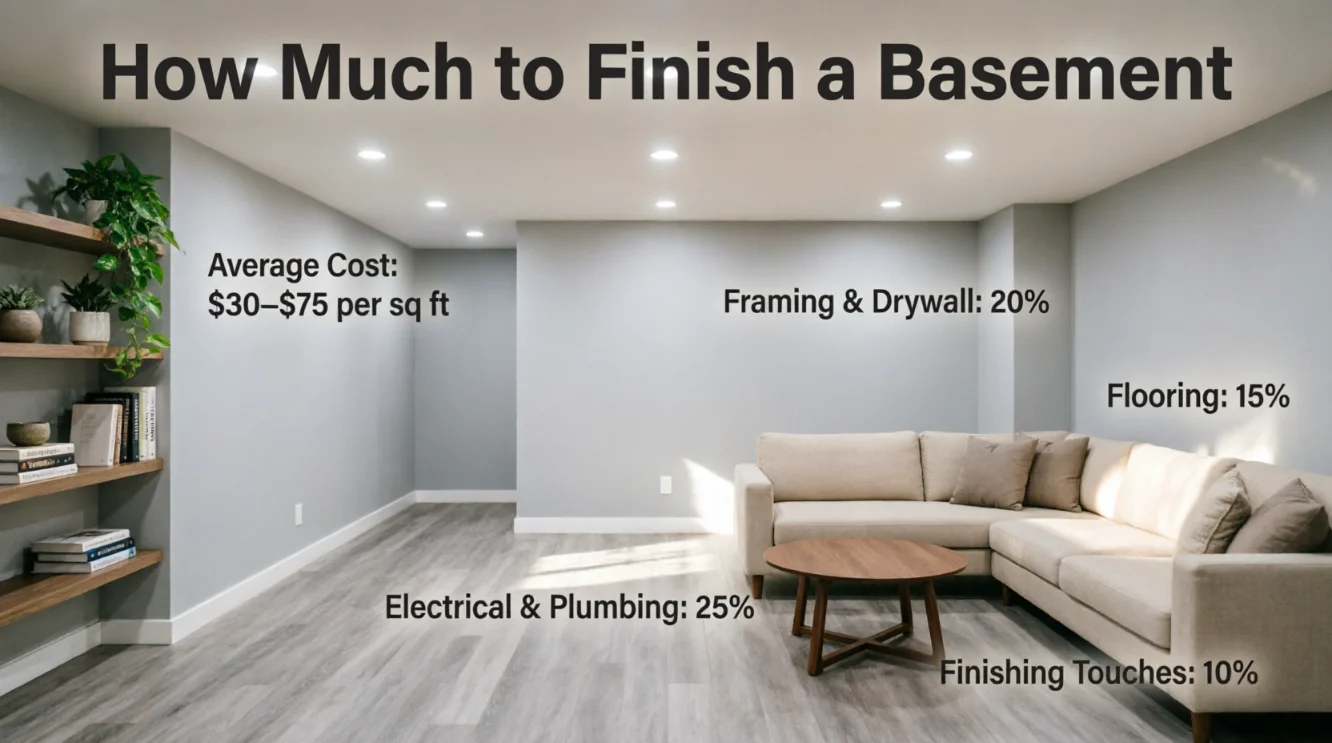
So, how much does it cost to finish a basement? In the U.S., a professional basement finishing project can commonly range from about $15,000 to $75,000, with many projects around $32,000. More comprehensive 2026 estimates put professional finishing around $30 to $75 per square foot, especially when the project includes upgraded finishes, additional rooms, or plumbing.
Key Takeaways
- A basic basement finish usually costs less than a project with bedrooms, bathrooms, or a kitchenette.
- A practical 2026 planning range is roughly $30–$75 per square foot for many professionally finished projects.
- A 1,000-square-foot basement could therefore require roughly $30,000–$75,000, depending on the scope.
- Plumbing, waterproofing, egress windows, and structural changes can raise the budget significantly.
- Get local quotes because labor, permits, basement condition, and building codes vary by location.
How Much Does It Cost to Finish a Basement?
The biggest mistake homeowners make is looking for one fixed basement finishing price. The cost depends heavily on what you want the finished space to become.
A simple recreation room with drywall, flooring, paint, lighting, and basic electrical work can cost much less than a basement containing a bedroom, full bathroom, wet bar, and home theater.
Current 2026 cost sources illustrate this difference. Angi and HomeAdvisor report a broad $15,000–$75,000 range and an average around $32,000, while other current estimates place many professional projects around $30–$75 per square foot. These numbers are not necessarily contradictory; the scope included in each estimate can differ.
Basement Finishing Cost by Square Foot
For initial budgeting, a range of $30–$75 per square foot can be useful for a more comprehensive professional finish.
| Basement Size | Approximate Cost at $30–$75/Sq. Ft. |
| 500 sq. ft. | $15,000–$37,500 |
| 750 sq. ft. | $22,500–$56,250 |
| 1,000 sq. ft. | $30,000–$75,000 |
| 1,250 sq. ft. | $37,500–$93,750 |
| 1,500 sq. ft. | $45,000–$112,500 |
| 2,000 sq. ft. | $60,000–$150,000 |
These figures are planning ranges, not quotes. A smaller basement can still cost a lot if it requires major plumbing, waterproofing, structural work, or new egress openings.
For comparison, Angi’s narrower base-finishing estimate is $7–$23 per square foot, showing why you should always check exactly what a contractor or cost guide includes in its definition of “finishing.”
What Does a Basement Finishing Project Include?
A typical basement finishing project can involve several different trades.
Framing and Insulation
Contractors usually frame walls in front of foundation walls and around rooms, doors, utilities, and mechanical equipment. Insulation helps improve comfort and energy performance.
However, moisture needs attention before insulation and drywall go in. The U.S. Department of Energy notes that basement moisture can contribute to mold, rot, and other problems when insulation and wall assemblies are installed incorrectly.
Drywall, Ceiling, and Flooring
Drywall creates finished walls, while your ceiling choice might include drywall, a drop ceiling, or another system that allows access to utilities.
Flooring can range from carpet and luxury vinyl plank to tile and other moisture-tolerant materials. Your choice affects both appearance and price.
Electrical, Lighting, and HVAC
A finished basement may need new outlets, switches, lighting, smoke alarms, and additional circuits. You may also need to extend the home’s heating and cooling system into the basement.
Electrical and HVAC requirements become more complicated when you add a bathroom, bedroom, kitchen area, or entertainment equipment.
Plumbing and Bathroom
A bathroom can dramatically change your budget because it introduces plumbing, fixtures, ventilation, waterproofing, flooring, and additional electrical work.
The location of existing plumbing also matters. A bathroom near an existing drain can be simpler than one requiring substantial new drainage work.
What Makes Basement Finishing More Expensive?
Several items can push your basement project well beyond a basic finish.
Moisture and Waterproofing
Deal with water before you finish the walls.
If your basement has leaks, seepage, condensation, or drainage problems, solve those issues before installing expensive finishes. The Department of Energy specifically emphasizes moisture control as a critical part of basement construction and insulation.
Possible work can include drainage improvements, sump-pump installation, foundation repairs, crack repairs, or waterproofing.
The exact cost depends on the source and severity of the moisture problem.
Egress Windows and Bedrooms
If you want to create a basement bedroom, check your local building requirements before starting.
The International Residential Code includes emergency escape and rescue requirements for basements and sleeping rooms, although local jurisdictions determine which version and amendments they enforce.
Adding an egress window can require cutting the foundation, excavation, a window well, drainage, and permits. That makes it considerably more expensive than simply replacing an existing basement window.
Bathrooms and Kitchenettes
Bathrooms and kitchenettes are among the biggest cost additions because they require plumbing and electrical work.
A basic open recreation room may avoid much of this expense. Once you add a bathroom, shower, toilet, sink, cabinetry, or kitchenette, the project becomes more complex.
Higher-End Finishes
Custom cabinets, premium flooring, built-ins, specialty lighting, home theaters, bars, heated floors, and luxury bathrooms can quickly move a basement from a basic renovation into a major remodeling project.
How Much Does It Cost to Finish a 1,000-Square-Foot Basement?
For a 1,000-square-foot basement, a reasonable starting budget for a professional finish is around $30,000–$75,000, using the broader 2026 $30–$75-per-square-foot planning range.
You might spend toward the lower end if you have:
- A dry basement
- Existing electrical and HVAC access
- No new bathroom
- No new bedroom egress
- Simple flooring
- Standard drywall and paint
- A straightforward open layout
You could move toward the upper end or beyond it if you add:
- A full bathroom
- Multiple bedrooms
- New egress windows
- A kitchenette or wet bar
- Extensive waterproofing
- Structural modifications
- Premium finishes
That is why two homeowners with identical 1,000-square-foot basements can receive very different estimates.
Do You Need Permits to Finish a Basement?
In many U.S. jurisdictions, basement finishing work requires permits, particularly when you modify electrical, plumbing, HVAC, structural elements, or create new habitable rooms.
The exact requirements vary by city and state, so check with your local building department before work begins.
Permits and inspections can add to the budget, but they also help confirm that the finished space meets applicable building and safety requirements. Current national cost guides commonly place permit costs around $1,200–$2,000, although local fees can differ substantially.
How Long Does It Take to Finish a Basement?
A straightforward basement finishing project can take roughly three to eight weeks of construction, according to current 2026 estimates. Permits, contractor scheduling, inspections, moisture repairs, and complicated plumbing can extend the overall timeline.
A simple open recreation room may move relatively quickly.
A basement with multiple rooms, a bathroom, new windows, or extensive mechanical work can take considerably longer.
Before signing a contract, ask the contractor for a written timeline that identifies major stages and inspection points.
Ways to Lower Your Basement Finishing Cost
You do not have to build the most expensive basement to create useful living space.
Consider these strategies:
Keep the layout simple. Fewer walls and rooms generally mean less framing, drywall, doors, electrical work, and finishing.
Use existing plumbing locations. Putting a bathroom near existing plumbing can reduce complicated drain and supply work.
Choose durable, practical materials. You can create an attractive basement without using the most expensive flooring, cabinets, or fixtures.
Finish the essentials first. If your budget is limited, prioritize moisture control, insulation, electrical, lighting, walls, flooring, and HVAC before decorative upgrades.
Get multiple detailed quotes. Ask each contractor to list labor, materials, permits, plumbing, electrical, flooring, and exclusions. A low headline price may not be cheaper if important work is missing.
Is Finishing a Basement Worth It?
If finishing a basement makes sense depends on how you plan to use the space and how long you expect to remain in the home.
A finished basement can give your family a recreation room, office, guest area, bedroom, gym, or entertainment space without building an entirely new addition.
It can also contribute to resale value. The 2025 Cost vs. Value report put the national average cost of a basement remodel at $52,012, with an estimated $36,905 in resale value, representing about 71% of the project cost recouped. Actual results vary by market and project.
So, resale value should not be the only reason to finish your basement. Consider the value you will get from using the space yourself.
Frequently Asked Questions
Is it cheaper to finish a basement yourself?
DIY work can reduce labor costs if you have the skills and time, particularly for painting, trim, some flooring, and other suitable tasks. However, electrical, plumbing, structural work, and required inspections may need licensed professionals depending on local rules. A mistake with moisture control or code requirements can also become expensive to correct.
What adds the most cost to finishing a basement?
Bathrooms and other plumbing-intensive additions can create major costs because they involve multiple trades. Egress windows, waterproofing, HVAC changes, structural work, and premium finishes can also substantially increase the budget. The exact biggest expense depends on the basement’s existing condition and your planned layout.
Can I finish a basement for $20,000?
It is possible in some situations, especially with a smaller basement, simple layout, modest finishes, and limited plumbing work. However, $20,000 may not cover a comprehensive professional finish in many U.S. markets. Current cost sources show that project scope and local conditions can produce very different totals.
Does a finished basement add value to a home?
It can. The 2025 national Cost vs. Value data estimated that a basement remodel recouped about 71% of its cost at resale. However, the actual return depends on your local housing market, workmanship, basement layout, and buyer demand.
Conclusion
So, how much does it cost to finish a basement? For many U.S. homeowners, a useful 2026 planning range is around $30–$75 per square foot, while broad national cost sources report projects from roughly $15,000 to $75,000 and an average near $32,000.
The final number depends less on square footage alone than on what you want to build. A simple recreation room can stay relatively affordable, while bathrooms, bedrooms, egress windows, waterproofing, and premium finishes can raise the price quickly.
Before starting, inspect the basement for moisture, confirm local permit requirements, define your desired rooms, and get detailed quotes from qualified local contractors.

Margaret Mitchell is the expert behind coupleanniversary. Transforming ordinary anniversaries into unforgettable memories. With unmatched insight in love, relationships, and celebration ideas, she guides couples to make every milestone special.