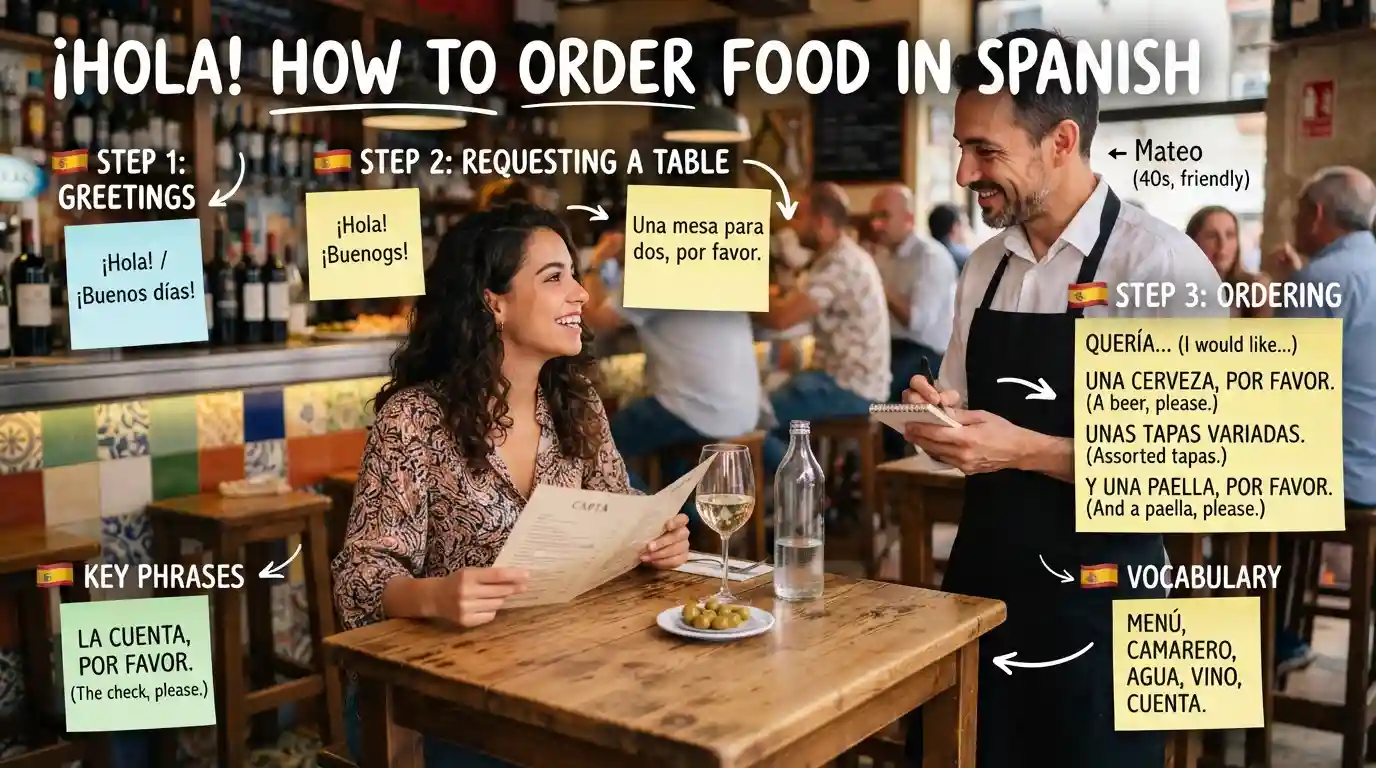
To order food in Spanish, use polite phrases such as “Quisiera…” (I would like…), “Me gustaría…” (I would like…), or “¿Me puede traer…?” (Can you bring me…?). Add “por favor” for politeness. You can also ask “¿Qué me recomienda?” for a recommendation and “La cuenta, por favor” when you are ready to pay.
Key Takeaways
- Quisiera… is a useful polite way to say “I would like…”
- ¿Qué me recomienda? means “What do you recommend?”
- Use ¿Qué lleva este plato? to ask what is in a dish.
- Say para llevar when you want your food to go.
- La cuenta, por favor means “The check, please.”
- Restaurant vocabulary can vary between Spain and Latin America, so you may hear different but equally natural expressions.
Start With These Basic Spanish Restaurant Phrases
If you’re learning Spanish for travel, you don’t need to memorize hundreds of words before visiting a restaurant. A small group of useful phrases can take you through most of a meal.
Here are some of the most important ones:
| Spanish | English |
| Hola | Hello |
| Una mesa para dos, por favor. | A table for two, please. |
| ¿Me trae el menú, por favor? | Can you bring me the menu, please? |
| Quisiera… | I would like… |
| Me gustaría… | I would like… |
| Para mí… | For me… / I’ll have… |
| ¿Qué me recomienda? | What do you recommend? |
| ¿Es picante? | Is it spicy? |
| La cuenta, por favor. | The check, please. |
These expressions cover many of the basic situations a beginner encounters at a restaurant.
How to Say “I Would Like”
One of the easiest patterns to remember is:
Quisiera + food or drink.
For example:
Quisiera los tacos, por favor.
I would like the tacos, please.
You can also say:
Me gustaría la sopa, por favor.
I would like the soup, please.
Both are useful polite expressions. You don’t have to translate every English sentence word for word. Learning these complete patterns makes ordering much easier.
How to Ask for the Menu
If you need the menu, you can say:
¿Me trae el menú, por favor?
Can you bring me the menu, please?
You may also hear la carta instead of el menú, particularly in Spain and some other Spanish-speaking settings.
How to Order Food in Spanish Step by Step
1. Greet the Server
Start naturally with a simple greeting.
Hola. — Hello.
Depending on the time of day, you can also say:
Buenos días. — Good morning.
Buenas tardes. — Good afternoon.
Buenas noches. — Good evening/night.
A greeting followed by por favor and gracias helps keep the interaction friendly and polite.
2. Ask About the Menu
If you haven’t received a menu, ask:
¿Me puede traer el menú, por favor?
Can you bring me the menu, please?
If you’re unsure what to choose, ask:
¿Qué me recomienda?
What do you recommend?
For a house specialty, you can ask:
¿Cuál es la especialidad de la casa?
What is the house specialty?
You can also ask about the daily special:
¿Cuál es el plato del día?
What is the dish of the day?
These types of questions appear frequently in Spanish restaurant guides because they help you communicate beyond simply naming an item.
3. Order Your Food
Once you’ve decided, keep your sentence simple.
Quisiera el pollo, por favor.
I would like the chicken, please.
Or:
Me gustaría una ensalada.
I would like a salad.
If you’re ordering with friends, para mí is especially useful:
Para mí, la pasta.
For me, pasta.
You may also hear or use ¿Me puede traer…?, meaning “Can you bring me…?” This is another practical ordering pattern.
4. Order Drinks
You can use the same patterns for beverages.
Quisiera un café, por favor.
I would like a coffee, please.
Quisiera agua, por favor.
I would like water, please.
If you are ordering several drinks, simply name each one clearly. You don’t need a complicated sentence.
5. Ask Questions About the Food
Sometimes the name of a dish doesn’t tell you everything you need to know. These phrases can help.
¿Qué lleva este plato?
What does this dish contain?
¿Es picante?
Is it spicy?
¿Viene con ensalada?
Does it come with salad?
¿Se puede hacer sin cebolla?
Can it be made without onion?
¿Qué ingredientes lleva?
What ingredients does it contain?
These questions are particularly useful when you’re unfamiliar with the menu or need to avoid certain ingredients.
6. Finish and Ask for the Check
When you’re finished eating, say:
La cuenta, por favor.
The check, please.
You can also use gracias when the server helps you.
If you’re in a Spanish-speaking country, remember that restaurant customs can differ by location. The basic language remains useful, but local vocabulary and dining practices may change.
Useful Spanish Phrases for Restaurants
Asking for Recommendations
When you don’t know what to order, use:
¿Qué me recomienda?
What do you recommend?
For a group:
¿Qué nos recomienda?
What do you recommend for us?
This is one of the easiest questions to memorize because it works for meals, drinks, and specialties.
Dietary Restrictions and Allergies
If you have a dietary restriction, communicate it clearly.
Soy vegetariano. — I’m vegetarian.
No como carne. — I don’t eat meat.
Soy alérgico a… — I’m allergic to…
Soy alérgica a… — I’m allergic to…
For a serious allergy, be as specific as possible and confirm that the dish is safe before eating it. Restaurant terminology and ingredient practices can vary by country, so don’t rely only on a single memorized phrase.
Asking About Spicy Food
If you don’t enjoy spicy food, this question is worth learning:
¿Es picante?
Is it spicy?
You can also ask:
¿Muy picante?
Very spicy?
If you want something without a particular ingredient:
Sin cebolla, por favor.
Without onion, please.
Ordering Food to Go
For takeout, learn:
Para llevar.
To go.
For example:
Quisiera un burrito para llevar, por favor.
I would like a burrito to go, please.
The phrase para llevar is widely used for takeaway or food that you don’t plan to eat at the restaurant.
What the Waiter May Ask You
Ordering food is easier when you understand the questions coming back to you.
A server might say:
¿Qué desea?
What would you like?
¿Qué van a pedir?
What are you going to order?
¿Están listos para ordenar?
Are you ready to order?
¿Qué les traigo de tomar?
What can I bring you to drink?
¿Algo más?
Anything else?
You don’t need to understand every word. If you recognize a few common restaurant questions, you can usually respond with the food or drink you want.
A Simple Spanish Restaurant Conversation
Here’s a short example you can practice:
Waiter: Hola. ¿Están listos para ordenar?
Customer: Sí, gracias. Quisiera los tacos, por favor.
Waiter: ¿Qué van a tomar?
Customer: Agua, por favor.
Waiter: ¿Algo más?
Customer: No, gracias. Eso es todo.
English:
Waiter: Hello. Are you ready to order?
Customer: Yes, thank you. I would like the tacos, please.
Waiter: What would you like to drink?
Customer: Water, please.
Waiter: Anything else?
Customer: No, thank you. That’s all.
Practice this dialogue aloud a few times. Then replace los tacos with another food and agua with another drink. This lets you build many new sentences from the same basic structure.
Common Mistakes to Avoid
Trying to translate every sentence word for word: Spanish and English don’t always structure requests in the same way. Learn useful patterns such as quisiera, me gustaría, and ¿me puede traer…? instead.
Forgetting polite words: Add por favor when making a request and gracias when someone helps you.
Assuming one phrase works everywhere: Spanish varies across countries and regions. For example, restaurant vocabulary and preferred expressions can differ between Spain and Latin America.
Being afraid of simple Spanish: You don’t need a perfect accent or advanced grammar to order a meal. A clear food name plus a polite phrase can be enough.
Quick Cheat Sheet
If you only have time to memorize a few phrases, start here:
- Hola. — Hello.
- Una mesa para dos, por favor. — A table for two, please.
- ¿Me trae el menú, por favor? — Can you bring me the menu, please?
- Quisiera… — I would like…
- Para mí… — For me…
- ¿Qué me recomienda? — What do you recommend?
- ¿Es picante? — Is it spicy?
- Sin cebolla, por favor. — Without onion, please.
- Para llevar. — To go.
- La cuenta, por favor. — The check, please.
With these phrases, you can handle many common restaurant situations without memorizing an entire conversation.
Frequently Asked Questions
How do I politely order food in Spanish?
Use “Quisiera…”, “Me gustaría…”, or “¿Me puede traer…?” followed by the food you want. Add “por favor” to make the request polite. For example, “Quisiera una sopa, por favor” means “I would like a soup, please.”
How do you say “I would like” in Spanish?
Two useful options are “Quisiera” and “Me gustaría.” Both can introduce a polite request. For example, “Quisiera un café” means “I would like a coffee,” while “Me gustaría una ensalada” means “I would like a salad.”
How do you ask for the check in Spanish?
Say “La cuenta, por favor.” It means “The check, please.” This short phrase is one of the most useful expressions to remember when dining at a Spanish-speaking restaurant.
How do you order food in Spanish?
Say “para llevar,” which means “to go” or “for takeaway.” For example, “Quisiera un sándwich para llevar, por favor” means “I would like a sandwich to go, please.”
What should I say if I don’t understand the waiter?
You can politely ask the person to repeat or explain something. A simple approach is “¿Puede repetir, por favor?” meaning “Can you repeat, please?” You can also ask for the menu in English if the restaurant offers one. The goal is clear communication, not perfect Spanish.
Conclusion
Learning how to order food in Spanish becomes much easier when you focus on a few practical patterns instead of trying to memorize an entire restaurant conversation. Start with “Quisiera…”, “¿Qué me recomienda?”, “¿Es picante?”, and “La cuenta, por favor.” Then practice adding different foods, drinks, and special requests.
Remember that Spanish-speaking countries use different regional expressions, so you may hear phrases that aren’t exactly the same as the ones in this guide. That’s normal.
The next time you visit a Spanish-speaking restaurant, try a few phrases yourself. Even simple Spanish can make ordering food more comfortable, practical, and enjoyable.

Dan Brown is a passionate relationship writer and anniversary message expert at coupleanniversary. With a deep understanding of love, marriage, and meaningful celebrations, he specializes in creating heartfelt anniversary wishes, romantic messages, and thoughtful words that help couples express their emotions perfectly.