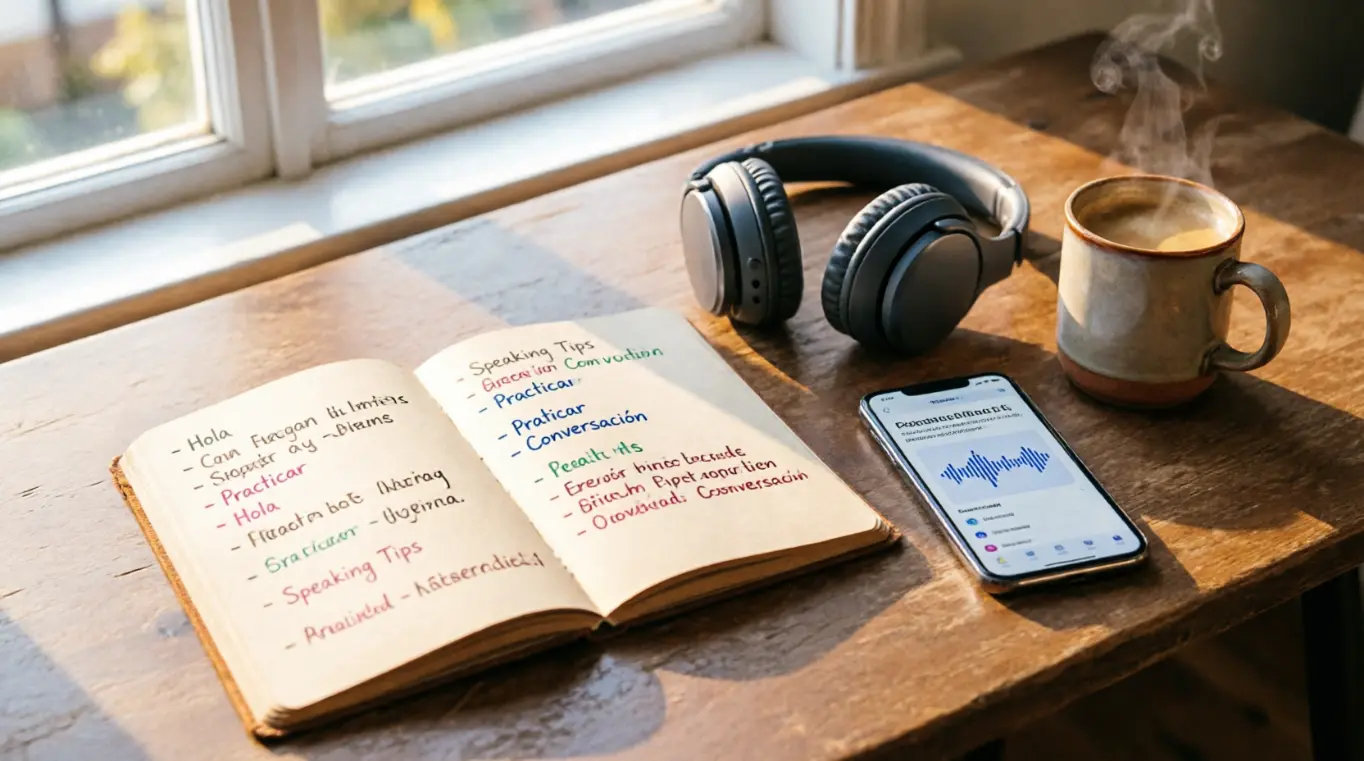
To practice Spanish speaking, spend a little time every day producing Spanish out loud. Talk to yourself, shadow native speakers, record your voice, answer questions, practice real-life situations, and have conversations with people when possible. Even short daily sessions can help you become more comfortable retrieving words and building sentences in real time.
Key Takeaways
- Speak Spanish aloud every day instead of relying only on reading and listening.
- Use self-talk, shadowing, recordings, and role-play when you have no partner.
- Practice real conversations to learn how to respond to unexpected questions.
- Focus on communicating your idea instead of waiting for perfect grammar.
- A short, consistent routine is easier to maintain than occasional long study sessions.
Why Speaking Spanish Requires Its Own Practice
You can understand Spanish and still struggle to speak it.
Maybe you recognize many words when you read them. You may even understand a Spanish video or follow a simple conversation. Then someone asks you a question in Spanish, and suddenly the words disappear.
That experience is normal.
Speaking requires you to retrieve words, build sentences, pronounce them, and respond to another person quickly. Reading and listening are useful, but they do not give you the same kind of active practice.
Current Spanish-learning resources commonly recommend combining solo production with interactive conversation. Solo exercises give you repetition, while real conversations force you to respond to unexpected language.
The good news is that you can start practicing today, even if you do not have a Spanish-speaking friend nearby.
9 Practical Ways to Practice Spanish Speaking
1. Talk to Yourself in Spanish
Self-talk is one of the easiest ways to start speaking Spanish without a partner.
Describe what you are doing as you move through your day.
For example:
Estoy preparando café.
Ahora voy a trabajar.
Tengo mucho que hacer hoy.
You do not need complicated vocabulary. Start with familiar activities such as cooking, shopping, cleaning, studying, or getting ready for work.
When you forget a word, describe it another way instead of immediately switching to English. This teaches you an important conversation skill: keeping your message going even when your vocabulary is incomplete.
2. Use the One-Minute Speaking Challenge
Choose a simple topic and speak about it for one minute.
Try topics such as:
- My favorite food
- My family
- My hometown
- A movie I enjoyed
- My weekend
- A place I want to visit
- My daily routine
Do not stop every few seconds to correct yourself.
For example, start with:
Me gusta mucho viajar.
Then add information:
Me gusta mucho viajar porque quiero conocer nuevos lugares.
Then add another idea:
Me gusta mucho viajar porque quiero conocer nuevos lugares y aprender sobre otras culturas.
This exercise teaches you to expand your answers instead of giving only one-word responses. Similar one-minute and timed speaking exercises appear frequently in current Spanish-speaking practice resources.
3. Shadow Native Spanish Speakers
Shadowing means listening to a Spanish speaker and repeating the words immediately or a moment behind them.
Choose a short clip with clear speech. Listen once. Then play it again and speak along with the speaker.
Pay attention to:
- Pronunciation
- Rhythm
- Intonation
- Word linking
- Natural pauses
Start with 20–60 seconds of audio. Repeat the same clip several times instead of constantly choosing new material.
Shadowing is especially useful when you understand Spanish but your speech still sounds slow or unnatural. It gives your mouth practice producing Spanish patterns rather than simply recognizing them.
4. Record Your Voice
Your phone can become a simple Spanish speaking practice tool.
Choose a question such as:
¿Qué hiciste hoy?
What did you do today?
Record yourself answering for one or two minutes.
Then listen to the recording.
Do not try to find every mistake. Instead, notice one or two things you want to improve. Maybe you paused too often, repeated the same word, or forgot a useful phrase.
Record the same answer again.
Comparing your attempts can help you notice progress that is difficult to feel while you are speaking.
5. Practice Real-Life Role-Plays
Instead of randomly speaking about grammar, practice situations you may actually experience.
For example:
At a café:
Order a drink and something to eat.
At a hotel:
Check in and ask about your room.
At a store:
Ask about a price, size, or color.
At an airport:
Ask where to find your gate.
Meeting someone:
Introduce yourself and ask questions about their life.
Practice the situation once. Then change one detail.
For example, order coffee the first time. The next time, order tea. Then ask for the bill.
This prevents you from memorizing one fixed script and makes you practice adapting your Spanish.
6. Answer Open-Ended Questions
A simple question can create several minutes of speaking practice.
Try questions like:
- ¿Qué te gusta hacer los fines de semana?
- ¿Cuál es tu comida favorita y por qué?
- ¿Qué hiciste ayer?
- ¿Dónde te gustaría viajar?
- ¿Qué película te gusta?
- ¿Cómo es tu ciudad?
Use the answer + detail + reason formula.
For example:
Me gusta la música. Escucho música todos los días porque me ayuda a relajarme.
You can then add another detail:
Especialmente me gusta la música pop porque tiene mucha energía.
This method helps you move from short answers toward connected conversation.
7. Practice With an AI Conversation Partner
AI conversation tools can give you an easy way to rehearse Spanish when a human partner is unavailable.
Ask for a specific situation rather than simply saying, “Talk to me in Spanish.”
For example:
Pretend you are a waiter in a Spanish restaurant. Speak at a beginner level and ask me one question at a time.
You can also request role-plays for travel, introductions, shopping, work, or everyday conversations.
Afterward, ask for feedback on your most important mistakes.
AI practice can provide low-pressure repetition, but it should complement rather than completely replace human conversation. Real people introduce unpredictable questions, interruptions, accents, and social cues that scripted practice may not reproduce.
8. Find a Human Conversation Partner
Eventually, you need opportunities to respond to another person.
A language exchange partner, tutor, Spanish-speaking friend, conversation group, or online community can provide this experience.
Do not wait until your Spanish is perfect.
Instead, tell your partner:
Estoy aprendiendo español. Por favor, habla un poco más despacio.
You can also ask them to correct only major mistakes during the conversation. Constant corrections can interrupt your flow, especially when you are still building confidence.
The goal is not to produce perfect Spanish. The goal is to communicate and keep the conversation moving.
9. Retell What You Hear or Read
Listen to a short Spanish story, watch a brief video, or read a simple passage.
Then close the material and explain what you remember in your own words.
For example:
El video habla de una familia que vive en Madrid. La familia tiene dos hijos…
You do not need to reproduce the original wording.
Retelling forces you to retrieve vocabulary and organize your own sentences. It is therefore different from simply repeating what you heard.
A Simple 20-Minute Spanish Speaking Routine
You do not need to spend hours practicing every day.
Try this 20-minute routine:
| Time | Activity |
|---|---|
| 3 minutes | Read or repeat familiar Spanish aloud |
| 5 minutes | Shadow a short native-speaking clip |
| 5 minutes | Speak about a familiar topic |
| 5 minutes | Practice a real-life role-play |
| 2 minutes | Review one mistake or useful phrase |
The exact number of minutes is less important than making speaking a regular part of your routine. Current Spanish-speaking guides commonly emphasize short, repeated practice rather than relying only on occasional long sessions.
On busy days, even five minutes can keep the habit going. On days when you have more time, add a conversation with another person.
What to Do When You Forget a Spanish Word
Do not immediately stop speaking.
Instead, explain the idea using words you already know.
Suppose you forget cuchillo (knife).
You could say:
La cosa que usamos para cortar.
That may not be the most elegant sentence, but it communicates your meaning.
This skill is called circumlocution: describing something when you cannot remember the exact word.
It is extremely useful in real conversations because you will not always know every word.
Keep a small list of words you could not remember. After your speaking session, look up a few of the most useful ones and use them again in a new sentence.
Common Mistakes That Slow Down Speaking Progress
Waiting until your Spanish is perfect
You do not need perfect grammar before speaking. If you wait for perfection, you delay the very practice that helps you improve.
Studying only vocabulary
Knowing individual words does not automatically make it easy to create sentences quickly.
Practice words inside useful phrases and complete sentences.
Translating everything in your head
Some translation is natural, especially for beginners. However, try to build simple Spanish phrases directly when you can.
Instead of translating every sentence from English, practice familiar Spanish expressions as complete chunks.
Speaking only when you have a partner
A conversation partner is valuable, but you can practice self-talk, shadowing, recordings, and role-play alone.
Correcting every mistake immediately
If you interrupt yourself after every error, speaking can become slow and stressful.
Finish your thought first. Review important mistakes afterward.
How Often Should You Practice Spanish Speaking?
Aim to speak Spanish regularly rather than saving all your practice for one long session.
A practical starting point is 10–20 minutes of active speaking most days, increasing the time when your schedule allows. Some current learning resources suggest 15–30 minutes of daily speaking output, while other guides recommend shorter sessions depending on the learner’s schedule.
The important point is that the time should include actual Spanish production.
Watching a Spanish movie can improve listening. Studying flashcards can improve vocabulary. Reading can strengthen comprehension.
Those activities are useful.
However, if your goal is speaking, make sure your mouth is producing Spanish regularly too.
Frequently Asked Questions
How can I practice speaking Spanish by myself?
Talk about your daily activities, answer questions aloud, record your voice, shadow native speakers, and practice role-play situations. You can also use AI conversation practice to simulate interactive conversations when another person is unavailable.
Can I learn to speak Spanish without a partner?
Yes. Solo practice can help you develop vocabulary retrieval, sentence building, pronunciation, and confidence. However, add real conversations when possible because another person gives you unpredictable questions and natural conversational feedback.
How long should I practice Spanish speaking each day?
Start with 10–20 focused minutes and build from there. Consistent practice is easier to maintain than occasional long sessions. Even a short session can include self-talk, shadowing, a speaking prompt, or a role-play.
What is the best way to improve Spanish conversation skills?
Use several methods together. Practice alone for repetition, shadow native speech for pronunciation and rhythm, and speak with real people for unpredictable conversation. This combination gives you both controlled practice and real communication experience.
Is it okay to make mistakes while speaking Spanish?
Yes. Mistakes are a normal part of speaking practice. Instead of trying to eliminate every error before you speak, focus on communicating your idea. Afterward, choose a few useful corrections and practice them again.
Conclusion
Learning how to practice Spanish speaking does not require a perfect accent, a Spanish-speaking country, or hours of free time. You can begin with a few minutes of self-talk, a one-minute challenge, shadowing, or a voice recording.
As you become more comfortable, add role-plays and real conversations. When you forget a word, describe it instead of giving up. When you make a mistake, keep communicating.
Most importantly, make speaking a regular habit. The more often you actively produce Spanish, the more familiar sentence building, vocabulary retrieval, and conversation become.
Start today with one simple question: ¿Qué hice hoy? Then speak for one minute without stopping.