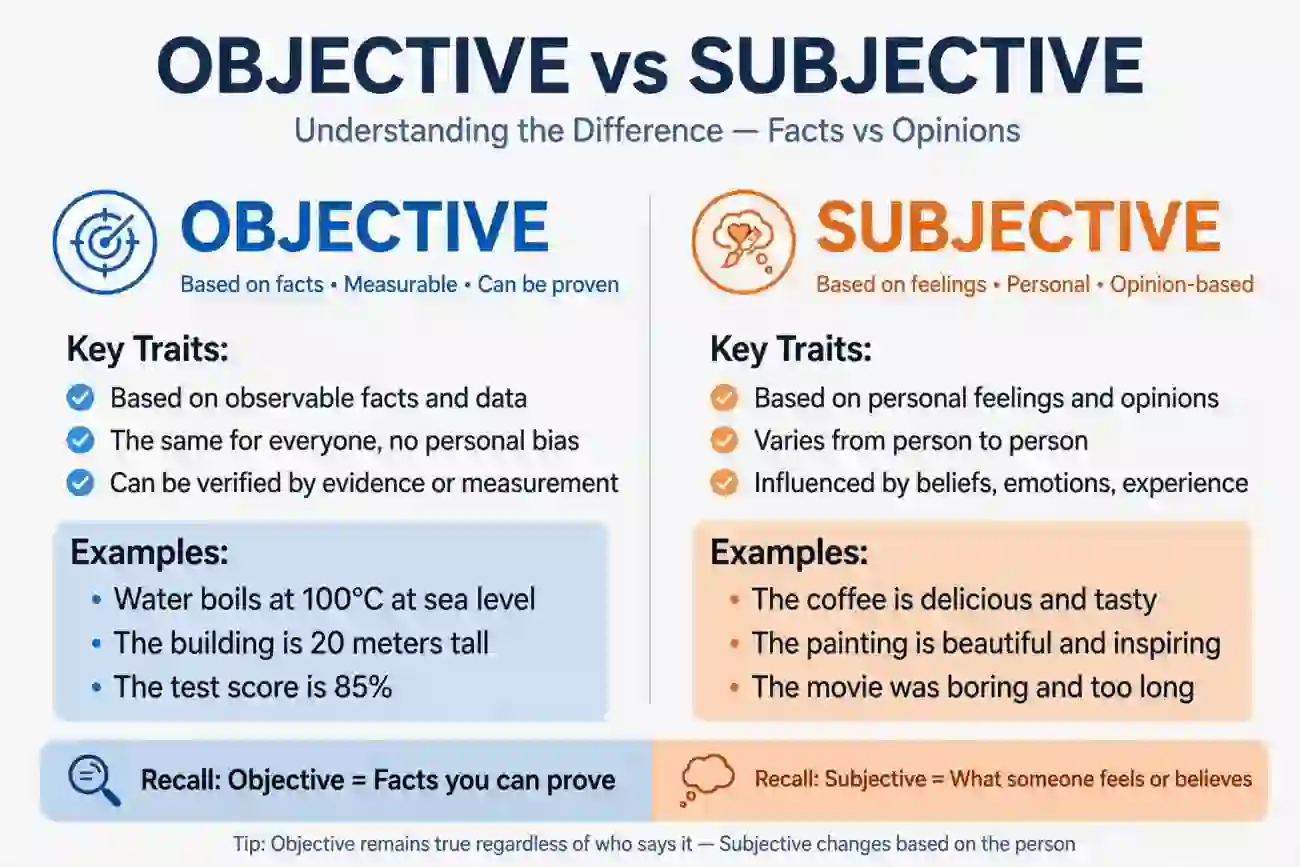
Objective vs subjective describes two different ways of presenting information. Objective information is based on facts, evidence, observations, or measurements that can be independently checked. Subjective information is shaped by personal feelings, opinions, experiences, preferences, or interpretations. In simple terms, objective focuses on what can be verified, while subjective focuses on personal perspective.
Key Takeaways
- Objective information relies on facts, evidence, measurements, or observable details.
- Subjective information reflects personal feelings, opinions, experiences, or preferences.
- Subjective does not automatically mean false or unreliable.
- A single statement can contain both objective information and subjective interpretation.
- A useful test is to ask whether the claim can be settled by checking reliable evidence.
What Does Objective Mean?
Objective means based on information that does not depend mainly on one person’s feelings or personal preferences. Objective claims can generally be checked through evidence, observation, records, measurements, or other reliable sources.
For example, consider this statement:
“The meeting started at 9:00 a.m.”
If there is a schedule, recording, or other reliable record showing the start time, the statement can be independently verified. That makes it objective.
Other examples include:
- The book has 250 pages.
- The store opens at 8 a.m.
- The team scored 72 points.
- The report contains 15 sections.
- The package weighs two pounds.
These statements focus on information that can be checked rather than on someone’s personal reaction.
Examples of Objective Statements
Here are a few simple examples:
| Objective statement | Why it is objective |
| The movie lasts 120 minutes. | Its running time can be measured. |
| The class begins at 10 a.m. | The schedule can verify it. |
| The phone has three cameras. | The physical feature can be observed. |
| The test contains 50 questions. | The number can be counted. |
| The store has four locations. | The number can be documented. |
Objective language is especially useful in academic writing, scientific communication, journalism, reports, instructions, and professional settings where separating evidence from personal preference is important.
What Does Subjective Mean?
Subjective describes something influenced by an individual’s personal feelings, opinions, preferences, experiences, or interpretation. Different people can reasonably have different subjective reactions to the same thing.
For example:
“That movie is boring.”
This is subjective because “boring” describes the viewer’s experience. Another person could watch the same movie and find it exciting.
Other examples include:
- This is the best restaurant in town.
- Blue is the prettiest color.
- The book is fascinating.
- That song is too loud.
- The vacation was amazing.
None of these statements is automatically wrong. They simply communicate a personal judgment rather than a fact that everyone must experience in exactly the same way.
Examples of Subjective Statements
| Subjective statement | Why it is subjective |
| The movie is amazing. | “Amazing” expresses an opinion. |
| This is the best pizza. | “Best” depends on personal taste. |
| The room feels uncomfortable. | Comfort varies between people. |
| That was an exciting game. | People can react differently. |
| This design looks beautiful. | Beauty is based on personal judgment. |
Objective vs Subjective: Key Differences
The easiest way to understand objective vs subjective is to compare the source of the information.
Objective information looks outward toward evidence, measurements, observations, and records. Subjective information looks toward the person’s perspective, feelings, preferences, or interpretation.
Objective vs Subjective Comparison Table
| Objective | Subjective |
| Based on facts or evidence | Based on personal perspective |
| Can usually be verified | May not be independently verifiable |
| Relies on observation or measurement | Relies on feelings or interpretation |
| Less dependent on personal preference | Strongly connected to personal experience |
| Often used in reports and factual writing | Often used in reviews and personal writing |
| Example: “The book has 300 pages.” | Example: “The book is fascinating.” |
This distinction is useful, but it is important not to oversimplify it. “Objective” does not mean that every statement is automatically true, and “subjective” does not mean that a statement is false. The key question is how the claim is established.
Objective vs Subjective Examples in Real Life
In School and Writing
Suppose a student writes:
“The article is 1,500 words long.”
That is objective if the word count can be checked.
Now consider:
“The article is extremely interesting.”
That is subjective because “interesting” reflects the student’s judgment.
A strong essay may contain both. The writer can use objective evidence to establish facts and then clearly identify interpretations or opinions.
In Reviews and Everyday Conversations
Imagine someone reviewing a restaurant.
Objective:
“The restaurant opens at 11 a.m. and offers 40 menu items.”
Subjective:
“The restaurant has the friendliest atmosphere in the city.”
The first statements can be checked. The second expresses a personal evaluation.
This is why good reviews often combine facts with opinions. Readers can use the factual information while understanding which conclusions come from the reviewer’s personal experience.
At Work
The same distinction appears in professional communication.
Objective:
“The project was submitted two days after the original deadline.”
Subjective:
“The project was handled poorly.”
The first statement identifies something that can be checked against dates. The second makes a judgment about performance.
If a workplace discussion becomes unclear, separating these two types of statements can make the conversation more productive.
How to Tell If Something Is Objective or Subjective
Try this simple five-step test:
1. Look for evidence.
Can you support the statement with a document, measurement, observation, record, or reliable source?
2. Ask whether another person can check it.
If two people have access to the same evidence, would they generally be able to evaluate the claim in the same way?
3. Look for opinion words.
Words such as best, beautiful, boring, amazing, terrible, and delicious often signal subjective judgment.
4. Separate the fact from the interpretation.
For example, “The restaurant received 4.7 stars” is factual, while “It is the best restaurant” is an interpretation.
5. Ask whether personal preference changes the answer.
If people can have different reasonable answers because of their tastes or experiences, the claim is likely subjective.
A useful shortcut is:
Can I settle this by checking? → More likely objective.
Does the answer depend on how someone feels or interprets it? → More likely subjective.
Is Subjective the Same as Biased?
Not necessarily.
Subjective information comes from a personal perspective, but that does not automatically make it dishonest, unfair, or useless. A person’s experience can be genuine even when it cannot be measured in the same way as a physical quantity.
For example, if someone says, “The room feels too cold,” that experience is subjective. Another person may feel comfortable in the same room.
Similarly, a patient’s description of pain is subjective because it depends on personal experience. That does not mean the person’s report should be dismissed.
Bias is a related but different concept. Bias involves a tendency that can influence judgment or presentation. A subjective statement may reveal a personal perspective without necessarily being intentionally biased.
Can a Statement Be Both Objective and Subjective?
Yes. Many real-world statements combine objective information with subjective interpretation.
Consider:
“The restaurant received 4.8 stars, so it is the best restaurant in town.”
The rating is potentially objective if it can be verified from a reliable source. The conclusion that it is the best is subjective because “best” depends on the criteria and the person’s judgment.
Another example:
“The movie is 140 minutes long, but it feels too long.”
The running time is measurable. The feeling that it is “too long” is subjective.
This is an important distinction in writing because separating facts from interpretations makes your communication clearer.
Common Mistakes to Avoid
One common mistake is assuming that adding the word “objectively” turns an opinion into a fact.
For example:
“Objectively, this is the greatest album ever made.”
The word “objectively” does not provide evidence. “Greatest” is still a value judgment unless specific, measurable criteria have been established.
Another mistake is assuming that subjective information is worthless. Personal experiences and opinions can be valuable, especially in reviews, interviews, storytelling, creative work, and discussions about preferences.
There is also a separate meaning of objective that can cause confusion. As a noun, an objective can mean a goal or something a person or organization wants to accomplish. For example, “Our objective is to finish the project by Friday.” This meaning is different from objective information.
Frequently Asked Questions
Is an opinion objective or subjective?
An opinion is generally subjective because it expresses a person’s judgment, preference, belief, or interpretation. For example, saying “This is the best movie” reflects personal evaluation. However, an opinion can be supported by objective evidence, so it is useful to distinguish the evidence from the opinion drawn from it.
Does subjective mean something is false?
No. Subjective does not mean false. It means that the statement depends on personal experience, feelings, preferences, or perspective. A person’s statement that a meal tastes delicious may be completely genuine even though another person may dislike the same meal.
Is objective always better than subjective?
No. Objective and subjective information serve different purposes. Objective information is especially useful when accuracy and verification matter. Subjective information is important when personal experience, taste, emotion, or interpretation is part of the subject. The better choice depends on what you are trying to communicate.
What is the easiest way to remember objective vs subjective?
Think objective = evidence and subjective = perspective. If a claim can generally be checked using measurements, records, observations, or other evidence, it leans objective. If it depends on someone’s feelings, preferences, or interpretation, it is subjective.
Conclusion
Understanding objective vs subjective becomes much easier when you focus on where a statement gets its meaning.
Objective information is based on facts, observations, measurements, or evidence that can generally be checked independently. Subjective information reflects personal feelings, experiences, preferences, or interpretations.
The two are not enemies, and one is not automatically better than the other. Strong communication often uses both: objective facts provide a foundation, while subjective perspectives explain how people interpret or experience those facts.
When you are unsure, ask one simple question: Can this claim be settled by checking evidence, or does it depend on someone’s perspective? That quick test will help you recognize the difference in school, work, writing, reviews, and everyday conversations.