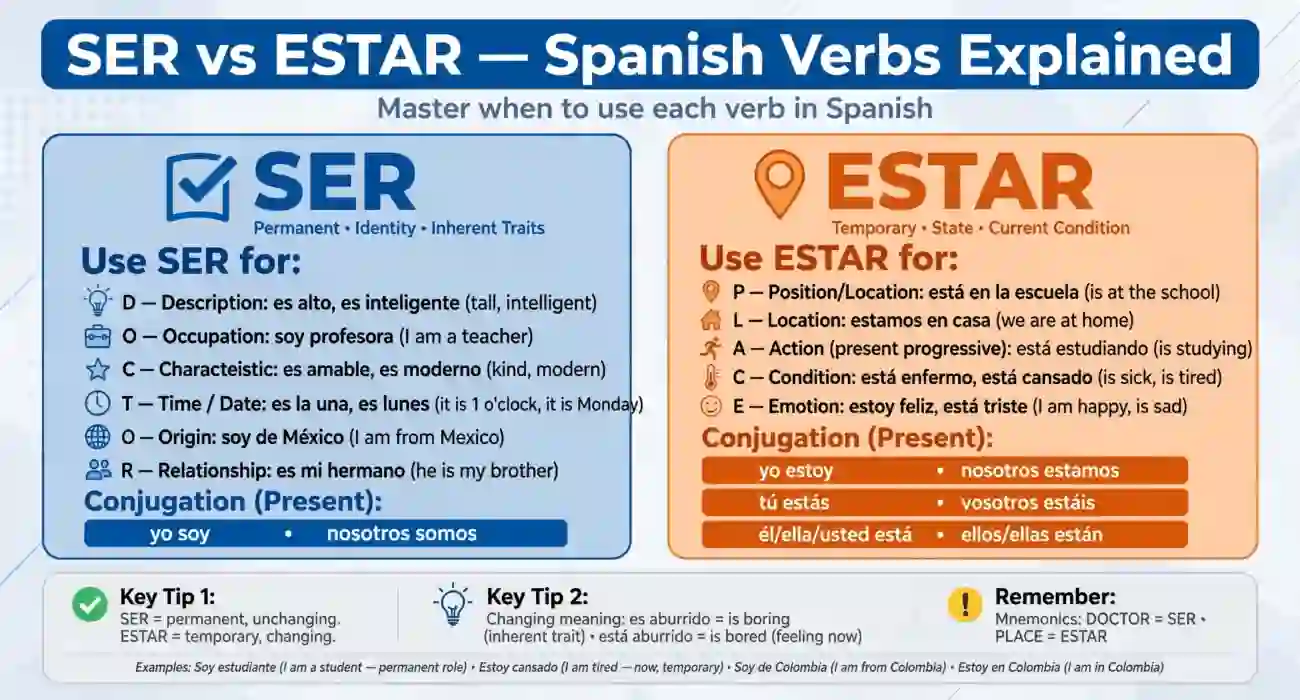
Ser vs estar are two Spanish verbs that both mean “to be,” but they serve different purposes. Use ser for identity, origin, profession, defining characteristics, time, and event locations. Use estar for physical location, emotions, conditions, and actions in progress. The easiest idea is: ser describes what something is; estar describes how or where it is.
Key Takeaways
- Ser usually identifies, classifies, or describes something.
- Estar usually describes a current state, condition, or location.
- The “permanent vs. temporary” rule is helpful but not always accurate.
- Physical people and things use estar for location, while events use ser.
- Some adjectives change meaning depending on whether they follow ser or estar.
What Is the Difference Between Ser and Estar?
For English speakers, ser vs estar can feel confusing because English uses one main verb, “to be.” Spanish divides many of those situations between two verbs.
Think of ser as answering questions such as:
“What is it?”
“Who is it?”
“What is it like?”
For example:
Soy estudiante. — I am a student.
Ella es mexicana. — She is Mexican.
El coche es rojo. — The car is red.
Estar, on the other hand, often answers:
“How is it?”
“Where is it?”
“What condition is it in?”
For example:
Estoy cansado. — I am tired.
Ella está en casa. — She is at home.
La puerta está abierta. — The door is open.
This distinction is more useful than simply memorizing “ser is permanent and estar is temporary.” That traditional shortcut works in many beginner examples, but it breaks down in important cases.
When to Use Ser in Spanish
Use ser when you are identifying, defining, classifying, or describing the nature of a person or thing.
Identity and Description
Use ser for identity and many defining characteristics.
- Soy Ana. — Soy Ana.
- Él es mi hermano. — He is my brother.
- Ella es inteligente. — She is intelligent.
- La casa es grande. — The house is big.
These sentences describe what someone or something is rather than a temporary condition.
Origin and Nationality
Use set to talk about where someone is from or their nationality.
- Soy de Texas. — I am from Texas.
- Ella es de México. — She is from Mexico.
- Somos estadounidenses. — We are American.
Origin is expressed with ser, even though someone can physically move from one place to another.
Occupation and Relationships
Professions, roles, and relationships normally use ser.
- Soy profesor. — I am a teacher.
- Mi hermana es doctora. — My sister is a doctor.
- Carlos es mi amigo. — Carlos es mi amigo.
- Ella es mi madre. — She is my mother.
Notice that a profession could technically change. Someone might be a teacher today and have another career later. That does not make estar correct. The important point is that Spanish treats the profession as an identity or classification.
Time, Dates, and Events
Spanish uses ser when stating the time or date.
- Son las tres. — It is three o’clock.
- Es la una. — It is one o’clock.
- Hoy es lunes. — Hoy es Monday.
- Mañana es martes. — Tomorrow is Tuesday.
Ser is also used to say when an event takes place:
La reunión es a las cinco.
The meeting is at five.
El concierto es el sábado.
The concert is Saturday.
Material, Possession, and Classification
Use ser to identify material or ownership.
- La mesa es de madera. — The table is made of wood.
- El anillo es de oro. — The ring is made of gold.
- El libro es de María. — The book belongs to María.
These examples classify or identify the thing rather than describe its current condition.
When to Use Estar in Spanish
Use stars for location, current conditions, emotions, and actions happening in progress.
Location
Use estar when talking about the physical location of people, animals, objects, and places.
- Estoy en casa. — I am at home.
- Ella está en la oficina. — She is at the office.
- El libro está en la mesa. — The book is on the table.
- Madrid está en España. — Madrid está en España.
An important point is that the location does not have to be temporary. A building can remain in exactly the same place for decades and still use estar for its physical location.
Feelings and Emotions
Use estar for many current feelings and emotional states.
- Estoy feliz. — I am happy.
- Estamos cansados. — We are tired.
- Ella está triste. — She is sad.
- Él está nervioso. — He estado nerviosa.
The focus is on the person’s current state.
Physical Conditions
Use estar for many temporary physical conditions or states.
- Estoy enfermo. — I am sick.
- Ella está cansada. — She is tired.
- El café está caliente. — El coffee es hot.
- La comida está fría. — The food is cold.
Results and States
Estar can describe the resulting condition of something.
- La puerta está cerrada. — The door is closed.
- La ventana está rota. — The window is broken.
- La tienda está abierta. — The store is open.
The focus is on the condition that exists now.
Actions in Progress
Spanish uses estar + gerund to express an action in progress.
- Estoy estudiando. — Estoy estudiando.
- Ella está trabajando. — She is working.
- Estamos comiendo. — We are eating.
- Están hablando. — They are talking.
This is another important use that cannot be explained simply by the permanent-versus-temporary rule. The construction describes an action that is currently happening.
Ser vs Estar Comparison Chart
| Use | Ser | Estar |
| Identity | Soy Ana. | — |
| Profession | Soy profesor. | — |
| Origin | Soy de México. | — |
| Nationality | Ella es mexicana. | — |
| Characteristic | Él es alto. | — |
| Time | Son las tres. | — |
| Physical location | — | Estoy en casa. |
| Emotion | — | Estoy feliz. |
| Physical condition | — | Estoy cansado. |
| Current state | — | La puerta está abierta. |
| Action in progress | — | Estoy estudiando. |
| Event location | La fiesta es aquí. | — |
This gives you a practical starting point, but context still matters.
Ser vs Estar for Location: The Important Exception
One of the biggest mistakes learners make is assuming that all locations use estar.
Physical things and people normally use estar:
El museo está en Madrid.
The museum is in Madrid.
Juan está en Madrid.
Juan is in Madrid.
But an event uses ser:
El concierto es en Madrid.
The concert is in Madrid.
La fiesta es en mi casa.
The party is at my house.
Why? The museum and Juan are physically located somewhere. The concert and party take place somewhere. Spanish distinguishes these ideas. This object-versus-event distinction is also supported by linguistic research on Spanish locative constructions.
A useful trick is to mentally replace “is” with “takes place.” If that works, ser is often the right choice.
Adjectives That Change Meaning With Ser and Estar
Some adjectives can take on different meanings depending on the verb.
Aburrido
Es aburrido.
He is boring.
Está aburrido.
He is bored.
The first describes a characteristic. The second describes a current feeling.
Listo
Es listo.
He is clever or smart.
Está listo.
He is ready.
Rico
Es rico.
He is rich.
Está rico.
It is delicious.
Malo
Es malo.
He is bad.
Está malo.
He is sick or unwell.
Verde
La manzana es verde.
The apple is green.
La manzana está verde.
The apple is unripe.
These examples show why choosing ser vs estar is not merely about whether something lasts forever. The verb can change the meaning of the entire statement.
Why “Permanent vs Temporary” Is Not Enough
You may have learned:
Ser = permanent
Estar = temporary
It is a useful beginner shortcut, but it should not become your only rule.
For example:
Soy joven. — I am young.
Youth is temporary, but Spanish uses ser.
On the other hand:
Estoy muerto. — I am dead.
Death is permanent, but Spanish uses estar.
Similarly, someone can be married for many years:
Está casado. — He is married.
And a person can have a profession that changes:
Es profesor. — He is a teacher.
So instead of asking only, “Is this permanent?” ask:
Am I identifying what something is, or describing its current state, condition, or location?
That question is much more reliable.
Common Ser vs Estar Mistakes
Here are several mistakes Spanish learners commonly make:
❌ Estoy profesor.
✅ Soy profesor.
A profession uses ser.
❌ Madrid está en España.
✅ Madrid está en España.
A physical location uses estar.
❌ La fiesta está en mi casa.
✅ La fiesta es en mi casa.
The party is an event, so its location uses ser.
❌ Soy cansado.
✅ Estoy cansado.
Being tired is a current physical state.
❌ Soy en casa.
✅ Estoy en casa.
Your physical location uses estar.
Learning these contrasts is often more effective than memorizing isolated definitions.
Easy Way to Remember Ser vs Estar
Try this two-question method:
1. What is it? → Ser
Ask whether you are identifying the subject, its origin, profession, relationship, material, time, or defining characteristics.
2. How or where is it? → Estar
Ask whether you are describing its current condition, emotion, physical location, or an action in progress.
Then remember the special location rule:
Person or thing → estar
Event → ser
For example:
El estadio está en Madrid.
The stadium is in Madrid.
El partido es en Madrid.
The game is in Madrid.
Once these patterns become familiar, choosing between the two verbs becomes much more natural.
Frequently Asked Questions
Is ser permanent and estar temporary?
Not exactly. “Permanent versus temporary” is a useful beginner shortcut, but it does not explain every case. Ser focuses more on identity, classification, and defining characteristics, while estar focuses on states, conditions, locations, and actions in progress. For example, Spanish says soy joven but estoy muerto.
Is location ser or estar?
For the physical location of a person, object, animal, or place, use estar. For the location where an event takes place, use ser. For example, El museo está en Madrid means “The museum is in Madrid,” while La exposición es en el museo means “The exhibition is at the museum.”
What is the easiest way to remember ser vs estar?
Think ser = what something is and estar = how or where something is. Then memorize the major groups: identity, origin, profession, characteristics, and time usually take ser; location, feelings, conditions, and ongoing actions usually take estar.
Does ser or estar change an adjective’s meaning?
Yes. Some adjectives change meaning depending on the verb. Es aburrido means “He is boring,” while está aburrido means “He is bored.” Similarly, es listo means “He is clever,” while está listo means “He is ready.”
Conclusion
Understanding ser vs estar becomes much easier when you stop treating them as two random translations of “to be.”
Use ser to identify and classify: who someone is, where they are from, what they do, what something is like, and when an event takes place.
Use estar to describe a current state, feeling, condition, physical location, or action in progress.
The most useful shortcut is simple: ser describes what something is; estar describes how or where it is. With practice, these two Spanish verbs become much easier to recognize and use naturally.

Margaret Mitchell is the expert behind coupleanniversary. Transforming ordinary anniversaries into unforgettable memories. With unmatched insight in love, relationships, and celebration ideas, she guides couples to make every milestone special.