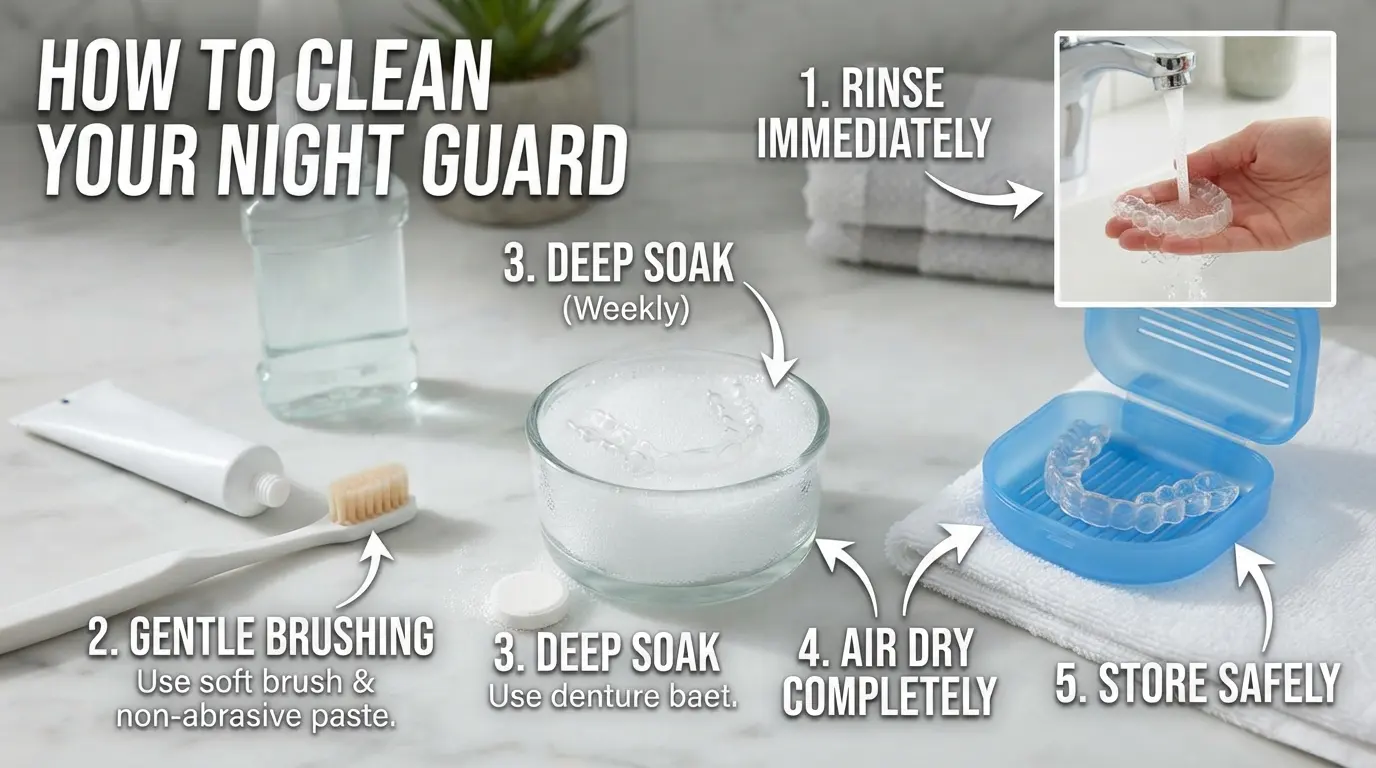
To clean a night guard, rinse it with cool or lukewarm water after each use, gently brush it with a soft toothbrush and an appropriate mild cleaner, rinse it thoroughly, and let it dry completely before storing it. For deeper cleaning, use a product specifically approved for your dental appliance and follow its instructions.
Key Takeaways
- Clean your night guard after every use rather than letting saliva and debris sit on it.
- Use cool or lukewarm water and gentle cleaning methods.
- Avoid hot water because heat can change the shape of some dental appliances.
- Check your guard’s manufacturer or dentist instructions before using tablets, vinegar, peroxide, or other cleaning solutions.
- Let the guard dry properly and keep its storage case clean and ventilated.
How to Clean a Night Guard Every Day
A night guard sits in your mouth for hours while you sleep. Saliva, plaque, and other debris can collect on its surface. A quick morning cleaning helps keep the appliance fresh and ready for the next night.
The basic routine is simple: rinse, gently clean, rinse again, dry, and store.
Step 1: Rinse It After Wearing
Take the night guard out as soon as you wake up and rinse it with cool or lukewarm water.
This helps remove loose saliva and debris before they dry onto the appliance. Avoid very hot or boiling water. Heat can distort some dental appliances and affect their fit.
If your dentist or the manufacturer gives you different temperature instructions, follow those instructions instead.
Step 2: Gently Brush the Guard
Use a soft-bristled toothbrush and gently clean the inside and outside surfaces.
For many night guards, a small amount of mild liquid soap is a practical choice. Rinse the guard thoroughly afterward so no soap remains. Several dental care guides recommend this gentle approach for routine cleaning.
Don’t scrub aggressively. Your goal is to remove buildup without scratching or damaging the material.
Step 3: Rinse Away Cleaner
After brushing, rinse the entire night guard under cool or lukewarm running water.
Pay attention to grooves, edges, and areas where the guard touches your teeth. You don’t want cleaner residue left on an appliance that will go back into your mouth.
Step 4: Let It Dry Completely
Place the clean guard on a clean surface and allow it to air-dry before putting it into its case.
Moisture trapped inside a closed container can contribute to unpleasant odors and microbial buildup. A ventilated storage container can help the appliance dry between uses. The American Dental Association also recommends ventilated storage for mouthguards so they can dry and help limit bacterial growth.
Step 5: Store It Properly
Once the night guard is dry, put it in a clean, protective case.
Keep the case somewhere cool and away from direct sunlight or excessive heat. Also keep it away from pets. Dogs, in particular, may treat a dental appliance as a chew toy.
If your dentist gave you specific storage instructions, use those instead. Some appliances have material-specific requirements.
How to Deep Clean a Night Guard
Daily brushing is the foundation of night guard care, but your appliance may occasionally need additional cleaning.
The safest approach is to choose a cleaner designed for removable dental appliances and make sure it is compatible with your particular night guard. The ADA recognizes a category of cleansers specifically designed to clean removable dental appliances, with safety and efficacy requirements for products that receive its Seal of Acceptance.
Follow the product’s directions carefully. Don’t assume that a cleaner designed for one type of dental appliance is automatically suitable for every night guard.
| Cleaning method | Best use | Important point |
| Cool/lukewarm water | Every day | Removes loose debris |
| Soft toothbrush + mild cleaner | Routine cleaning | Brush gently |
| Appliance cleaning product | Deeper cleaning | Follow product directions |
| Denture/appliance tablets | Only when compatible | Check manufacturer instructions |
| Vinegar or peroxide | Not a universal solution | Use only if your appliance instructions allow it |
The table is intentionally cautious because night guards can be made from different materials. A method that works for one appliance may not be appropriate for another.
Can You Clean a Night Guard With Toothpaste?
This is one of the most confusing questions because dental guidance is not completely uniform.
The American Dental Association’s general mouthguard guidance says some mouthguards can be brushed with toothpaste, while other dental professionals recommend avoiding regular toothpaste because certain formulas can be abrasive.
For that reason, don’t assume toothpaste is safe for your particular night guard.
If your dentist or manufacturer specifically recommends toothpaste, follow that instruction. Otherwise, a soft toothbrush with an appropriate mild cleaner is a reasonable routine option for many appliances.
Whitening toothpaste and other highly abrasive products are especially worth avoiding unless your appliance instructions specifically approve them.
How to Remove Smell, Cloudiness, or Stains
A bad smell often means the guard needs better cleaning and drying.
Start by returning to the basics:
- Rinse the guard immediately after wearing it.
- Clean all surfaces gently.
- Rinse thoroughly.
- Let it dry completely.
- Clean the storage case regularly.
If the odor continues, consider an appliance-specific cleaning product that is compatible with your guard.
A cloudy or yellow appearance can have several causes, including buildup, staining, or changes in the appliance material. Don’t automatically assume that a strong household cleaner will solve the problem.
If the guard remains discolored after appropriate cleaning, develops cracks, becomes warped, or no longer fits correctly, ask your dentist to inspect it. A damaged appliance may need replacement rather than stronger cleaning.
What Not to Use on a Night Guard
Some cleaning mistakes can damage the appliance.
Avoid Very Hot Water
Don’t use boiling or very hot water unless the manufacturer specifically tells you to do so for a particular purpose. Heat can deform some dental appliances.
Don’t Use Harsh Household Cleaners
Bleach, powdered household cleaners, and other strong chemicals can damage some dental appliances. The ADA specifically advises against bleach and powdered household cleansers for dentures.
Night guards are not identical to dentures, so the safest rule is to use only products approved for your specific appliance.
Don’t Soak It in Random Solutions
Vinegar, hydrogen peroxide, alcohol-based mouthwash, and other homemade cleaning mixtures appear frequently in online advice. However, they are not universal solutions for every night guard.
Material compatibility matters. Before using any chemical soak, check the manufacturer’s instructions or ask your dentist.
Don’t Store It Wet in a Closed Case
Dry the appliance first unless your specific manufacturer tells you to store it differently.
How to Clean the Night Guard Case
Don’t forget the case.
A clean night guard can become dirty again if you repeatedly put it into a contaminated or damp container.
Wash the case according to its care instructions and allow it to dry completely. You can use mild soap and water for many cases, but check the manufacturer’s instructions if the case has special materials or components.
The ADA recommends storing mouthguards in sturdy containers that allow air circulation.
When Should You Replace a Night Guard?
Cleaning cannot repair a night guard that has become damaged.
Have your dentist check the appliance if you notice:
- Cracks or holes
- Significant thinning
- Warping
- Sharp edges
- A major change in fit
- Persistent odor despite proper cleaning
- Damage from grinding or chewing
- Mouth or gum irritation while wearing it
The correct replacement schedule varies because night guards differ in material, design, and how heavily they are used. Rather than replacing every guard on a fixed schedule, follow your dentist’s recommendation and replace it when its condition or fit calls for it.
The American Dental Association recommends checking mouthguards for wear and damage and discussing replacement timing with your dentist.
Frequently Asked Questions
Can I clean my night guard every day?
Yes. Daily cleaning is a good habit. Rinse it after every use and gently clean it according to the appliance’s care instructions. Regular cleaning removes saliva and debris before they have more time to accumulate.
How often should I deep clean my night guard?
There is no single deep-cleaning schedule that fits every night guard. Follow the instructions from your dentist, manufacturer, or the cleaning-product label. Daily rinsing and routine cleaning should remain the foundation of your care.
Can I use denture cleaning tablets on a night guard?
Only if the product is compatible with your particular night guard. Some dental appliance cleansers are designed for removable appliances, but materials differ. Check the night guard’s instructions before soaking it.
How do I get the smell out of my night guard?
Clean it thoroughly after each use, rinse away all cleaner, and let it dry completely before storage. Also clean the case. If the smell continues despite proper care, have your dentist inspect the appliance.
Can hot water damage a night guard?
It can. Some dental appliances can warp when exposed to excessive heat, which may change their fit. Use cool or lukewarm water for routine cleaning unless your specific appliance instructions say otherwise.
Why is my night guard turning cloudy?
Cloudiness can result from buildup, staining, or changes in the appliance material. Try the cleaning method recommended for your specific guard. If the cloudiness does not improve or the appliance’s fit has changed, ask your dentist to examine it.
Can I clean my night guard with mouthwash?
Don’t assume that mouthwash is suitable for every night guard. Some online guides recommend certain mouthwashes, while appliance manufacturers may give different instructions. Check your guard’s care instructions before soaking it in mouthwash.
Should I take my night guard to my dental appointments?
Yes. Bringing the appliance to dental visits can allow your dentist to check its condition and fit. The ADA recommends bringing mouthguards to regular dental checkups for evaluation.
Final Thoughts
Learning how to clean a night guard does not need to be complicated. The most useful routine is consistent: rinse the appliance after wearing it, gently clean it with a method appropriate for its material, rinse it well, let it dry, and store it properly.
For deeper cleaning, choose a product specifically intended for removable dental appliances and follow its directions. Avoid assuming that toothpaste, vinegar, peroxide, mouthwash, or other household products are safe for every type of night guard.
Most importantly, pay attention to your appliance. If it becomes damaged, warped, uncomfortable, or difficult to clean, ask your dentist if it should be replaced.