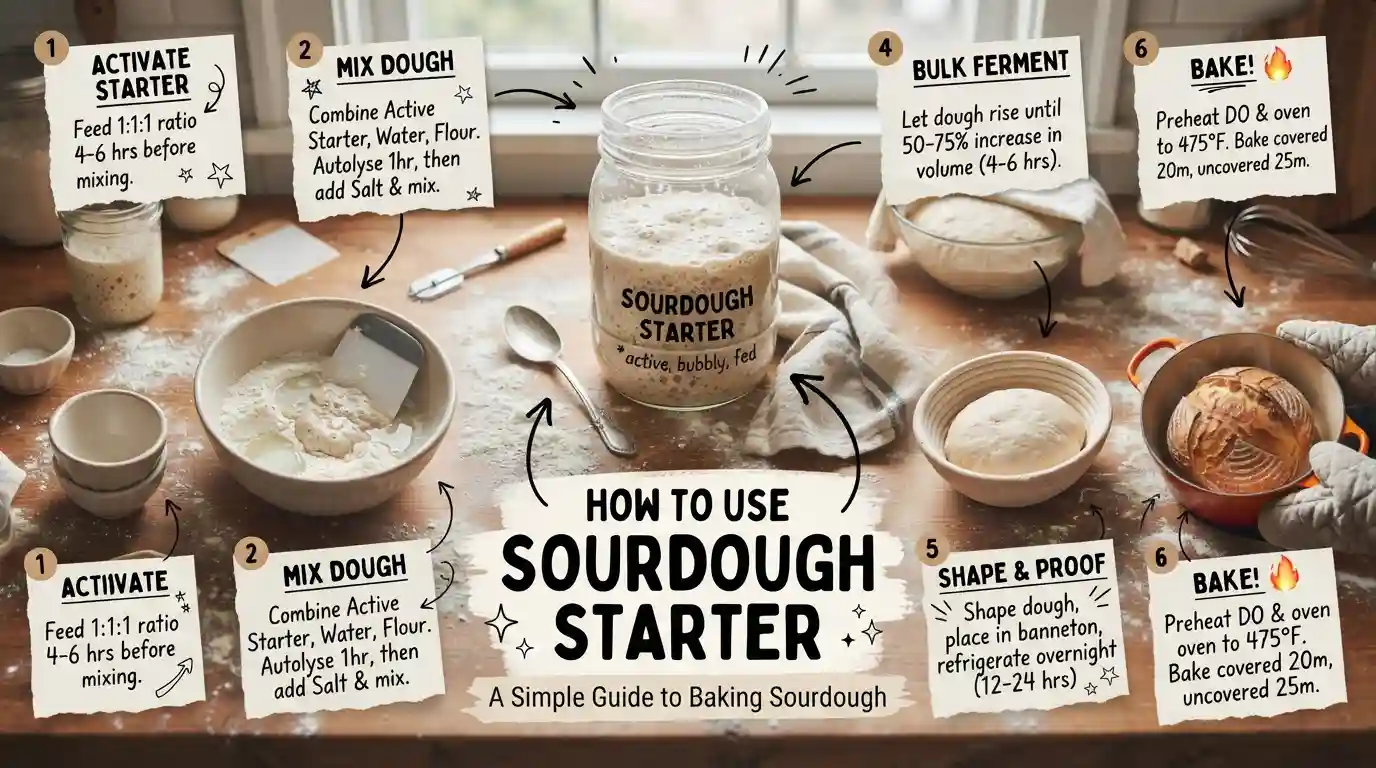
To use sourdough starter, first feed it with flour and water, then let it become bubbly and active. When it has risen and roughly doubled in size, measure the amount your recipe calls for and mix it into your dough. Keep a small portion behind to feed and maintain for your next bake.
Key Takeaways
- Use an active, bubbly starter when you want it to help bread rise.
- Feed your starter with flour and water before baking if it is hungry or refrigerated.
- A healthy starter often roughly doubles after feeding and shows plenty of bubbles.
- Sourdough discard can be used for pancakes, waffles, crackers, muffins, and other recipes.
- Store your starter in the refrigerator if you do not bake frequently.
What Is Sourdough Starter?
Sourdough starter is a living mixture of flour and water that contains wild yeast and beneficial bacteria. These microorganisms ferment the mixture and produce gas, which helps sourdough dough rise.
Think of your starter as a small baking culture that you keep alive. You feed it flour and water, allow it to become active, and then use part of it in a recipe.
The important thing to remember is that not every starter is ready to bake with at every moment. A starter that has been sitting in the refrigerator or has gone a long time without feeding usually needs to be refreshed first.
For bread, you generally want a starter that is bubbly, expanded, and active. King Arthur Baking recommends using ripe starter when it has roughly doubled in volume and become bubbly, often around 6 to 8 hours after feeding, although timing varies with temperature and starter strength.
How to Use Sourdough Starter Step by Step
1. Check Your Starter
Start by looking at your starter.
A healthy, active starter should show bubbles and signs of fermentation. It should have a pleasantly sour, tangy, yeasty, or slightly fruity smell.
If your starter has been stored in the refrigerator, it may have a layer of liquid on top. This is commonly called hooch. It can appear when the starter has used up much of its available food. You can stir it in or pour it off before feeding.
However, visible mold, pink or orange streaks, or a putrid smell are reasons to discard the starter rather than bake with it.
2. Feed the Starter
If your starter needs feeding, remove a manageable amount and add fresh flour and water.
A simple beginner feeding is:
- 50 grams sourdough starter
- 50 grams water
- 50 grams flour
This is a 1:1:1 feeding ratio by weight. In other words, you use equal weights of starter, water, and flour. This is a useful starting point, although bakers use many different feeding ratios.
Mix everything thoroughly and place it in a clean container. Cover it so it does not dry out, but allow the fermenting starter enough room to expand.
Using a kitchen scale makes sourdough measurements much easier because flour and starter can vary considerably by volume.
3. Wait for It to Become Active
Now give your starter time to ferment.
As it becomes active, you should see bubbles throughout the mixture and an increase in volume. Mark the starter’s level on the side of the jar with a rubber band or piece of tape. This makes its growth easier to see.
For many starters, the ideal baking point is when it has roughly doubled and looks lively and bubbly. The exact timing depends on factors such as room temperature, feeding ratio, flour, and the health of the starter.
Do not rely on the clock alone. Look at the starter as well as the time.
4. Measure the Amount Your Recipe Needs
Once the starter is active, check your recipe.
Suppose your recipe calls for 100 grams of active sourdough starter. Measure 100 grams and set it aside for your dough.
Remember to keep some starter for your next feeding.
For example, if you have 150 grams of active starter and your recipe needs 100 grams, do not use the entire jar unless you are planning to create a new starter afterward. Save a portion and feed it again.
If you need more starter than you currently have, you can build the quantity with a larger feeding. The amount of flour and water you add should be planned around the quantity your recipe requires plus the starter you want to keep.
5. Add It to Your Dough
Add the active starter to the other ingredients according to your sourdough recipe.
At this point, the starter acts as the leavening culture for the dough. You may then mix, rest, stretch and fold, shape, proof, and bake according to the particular recipe.
The starter itself is only one part of sourdough baking. Your recipe also controls the amount of flour and water, fermentation schedule, salt, dough temperature, shaping, and baking method.
That is why it is best to follow a tested sourdough recipe rather than simply adding starter to an unrelated bread recipe.
How Much Sourdough Starter Should You Use?
There is no single amount that works for every sourdough recipe.
Some recipes may call for a relatively small amount of starter and use a longer fermentation. Others use more starter and ferment for less time.
The easiest approach is to follow the recipe’s stated amount.
If a recipe calls for 100 grams of starter, use 100 grams. If it calls for 150 grams, use 150 grams.
Also remember that sourdough starter contains both flour and water. A common starter maintained with equal weights of flour and water is approximately 100% hydration. Changing the amount of starter can therefore change the flour, water, fermentation, and timing of a recipe.
For beginners, weighing the starter in grams is much more reliable than measuring it by cups.
Active Starter vs. Sourdough Discard
One of the most important things to understand is the difference between active starter and discard.
| Type | What it means | Common use |
| Active starter | Recently fed, bubbly, and rising | Sourdough bread and other naturally leavened doughs |
| Discard | Starter removed during feeding or starter that is not at peak activity | Pancakes, waffles, crackers, muffins, and other recipes |
Active starter is what you normally want when the starter needs to provide significant leavening.
Discard is the portion removed during routine feeding. You do not always have to throw it away. It can be saved for recipes designed for unfed or discard starters.
For example, sourdough discards can add flavor to pancakes, waffles, quick breads, crackers, and similar recipes.
How to Use Sourdough Starter From the Fridge
If you keep your starter refrigerated, do not assume it is immediately at peak strength when you take it out.
Remove it from the refrigerator and let it warm somewhat at room temperature. Then feed it and give it time to become active.
If it has been neglected for a while, it may need several feedings before it becomes strong enough for bread. King Arthur Baking recommends feeding refrigerated starter repeatedly until it reliably doubles within about 6 to 8 hours before baking.
For occasional bakers, refrigerator storage can make starter maintenance easier. A common approach is to feed a refrigerated starter about once a week and refresh it again before baking.
What Can You Make With a Sourdough Starter?
Once you understand how to use sourdough starter, you can make much more than a basic loaf of bread.
Depending on the recipe, you can use active starter or discard for:
- Sourdough bread
- Pizza dough
- Flatbreads
- Pancakes
- Waffles
- Crackers
- Muffins
- Quick breads
- Some cakes and other baked goods
Active starter is especially useful when the recipe depends on fermentation and natural leavening. Discard works well in recipes where the starter contributes flavor and texture without being the primary leavening source.
Common Sourdough Starter Problems
Starter Is Not Rising
A weak starter may need more regular feeding or more time at a suitable temperature.
Temperature matters because fermentation speeds up in warmer conditions and slows down in cooler ones. If your starter is consistently sluggish, continue regular feedings and watch for increasing bubbles and volume.
A new starter can also take several days to become reliably active. King Arthur’s current starter guidance notes that a young starter may need additional days of feeding if it has not begun doubling consistently.
Liquid Is Sitting on Top
A liquid layer is often called hooch. It usually means the starter has become hungry.
You can stir it back in or pour it off, then feed the starter. Dark liquid alone does not necessarily mean the starter has spoiled.
Starter Has Mold or an Unusual Color
Do not bake with a starter that has visible mold or pink or orange discoloration.
Colorado State University Extension advises discarding starter that shows mold, while King Arthur Baking similarly recommends starting over when mold or pink/orange coloration appears.
How to Maintain Sourdough Starter
If you bake several times a week, you may prefer keeping your starter at room temperature and feeding it regularly.
If you bake less often, refrigerator storage is more convenient. Feed it, let it become active, and then refrigerate it in an appropriate covered container.
When you are ready to bake again, bring it out, feed it, and wait for strong signs of activity before using it.
The goal is simple: keep a small amount of healthy starter alive, feed it when needed, and build enough active starter for your recipe when you plan to bake.
Frequently Asked Questions
Do you use sourdough starter before or after feeding?
For bread recipes that rely on starter for leavening, use it after feeding when it has become active, bubbly, and expanded. A mature starter often roughly doubles after feeding before it reaches a useful baking stage.
Can you use sourdough starter straight from the fridge?
You can use a refrigerated starter in some recipes, but it may not be strong enough for bread immediately. For reliable leavening, feed it and allow it to become active before using it. A neglected starter may require several feedings.
How do you know when the sourdough starter is ready?
Look for noticeable bubbling, expansion, and a roughly doubled volume after feeding. A healthy starter should also have a pleasant sour or yeasty aroma. The exact timing varies with temperature and feeding schedule.
Can you use sourdough discard for baking?
Yes. Sourdough discard can be used in many recipes, including pancakes, waffles, crackers, muffins, and quick breads. Because the discard contains flour and water, recipes may need adjustments when you substitute it for part of their ingredients.
Conclusion
Learning how to use sourdough starter becomes much easier once you understand its basic cycle. Feed it, let it become active, use the amount your recipe requires, and save some starter for the next feeding.
For sourdough bread, look for a bubbly starter that has risen substantially after feeding. If your starter lives in the refrigerator, give it time to warm up and become active before baking. And instead of automatically throwing away your discard, use it in pancakes, waffles, crackers, and other recipes.
With a little practice, you will start recognizing when your starter is hungry, when it is ready to bake, and when it simply needs another feeding.

Margaret Mitchell is the expert behind coupleanniversary. Transforming ordinary anniversaries into unforgettable memories. With unmatched insight in love, relationships, and celebration ideas, she guides couples to make every milestone special.