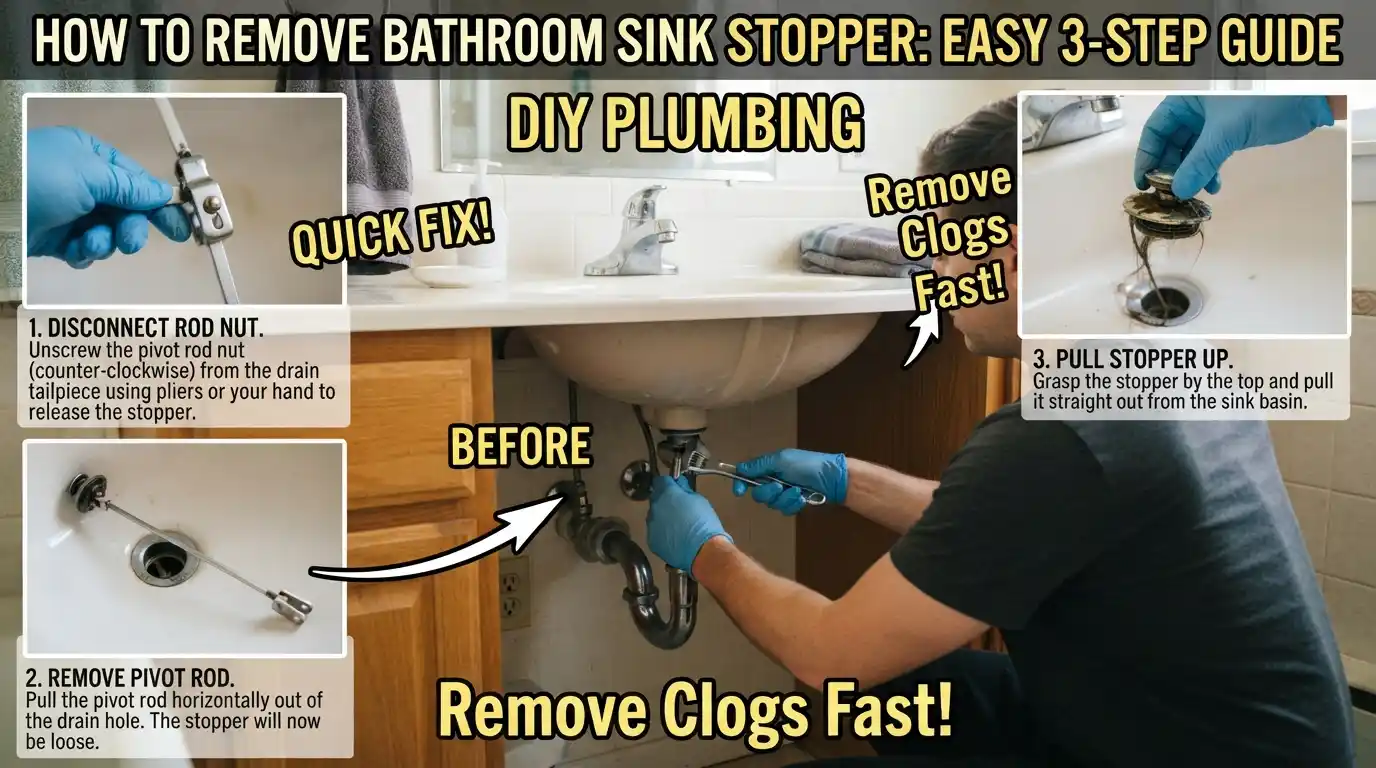
To remove a bathroom sink stopper, first identify its type. A traditional pop-up stopper usually requires you to disconnect the horizontal pivot rod under the sink before lifting the stopper out. Push, twist, and lift-and-turn stoppers may come out directly from above. Use gentle force and avoid prying against the sink.
Key Takeaways
- Check the stopper type before trying to remove it.
- A traditional pop-up stopper is usually held by a horizontal pivot rod.
- You normally do not need to remove the P-trap to remove the stopper itself.
- Take a photo of the linkage before disconnecting anything.
- Clean the stopper and drain before reinstalling it.
- Always check the connections for leaks after reassembly.
Identify Your Bathroom Sink Stopper Type
Before reaching for pliers, look at how your bathroom sink stopper works. The removal process can be very simple or require a few steps under the sink.
The most common bathroom sink design is a lift-rod pop-up stopper. You will see a small rod behind the faucet. Pulling or pushing this rod raises or lowers the stopper. Under the sink, a linkage connects the lift rod to a horizontal pivot rod that enters the drain body. Kohler describes this mechanism as a lift rod connected to a linkage and ball-rod assembly.
Other bathroom sinks use a stopper that you operate directly from the drain.
Lift-Rod Pop-Up Stopper
Look for a small lift rod behind the faucet. Under the sink, you should also see a vertical strap, spring clip, and horizontal rod.
For this style, the horizontal rod usually holds the stopper in place. You need to disconnect that rod before the stopper will lift completely out.
Push, Twist, and Lift-and-Turn Stoppers
Some stoppers have no under-sink linkage. You may open them by pressing, twisting, pulling, or turning the stopper.
If the stopper lifts easily from above, try that method first. Do not automatically start taking apart the plumbing underneath.
If it rises slightly and then stops, however, it may be connected to a pivot rod beneath the sink.
Tools You May Need
For a standard pop-up stopper, gather:
- Adjustable pliers or wrench
- Small bucket or bowl
- Old towel or rag
- Flashlight
- Rubber gloves
- Soft brush or old toothbrush
- Mild dish soap
You may not need every item. In many cases, your hands are enough to loosen the retaining nut and disconnect the linkage.
A flashlight is especially useful because the area behind the drain can be difficult to see.
How to Remove a Bathroom Sink Stopper
Follow these steps for a traditional lift-rod pop-up stopper.
1. Clear the Area Under the Sink
Remove bottles, cleaning products, and other items from beneath the sink.
Place a small bucket or bowl under the drain connection. A little water may escape when you loosen the pivot rod, so keep a towel nearby.
You usually do not need to shut off the faucet’s water supply simply to remove the stopper. However, keep the faucet off while you are working on the drain.
If you recently poured chemical drain cleaner into the sink, do not immediately open the drain connections. Follow the product’s safety instructions because leftover chemicals may be hazardous.
2. Try Removing the Stopper From Above
Put the stopper in its open position.
Grip the stopper gently and try lifting it straight up. Some designs come out without disconnecting anything underneath.
If it does not come out, don’t pull harder.
Instead, look underneath the sink for the horizontal rod entering the back or side of the drain. Delta’s instructions explain that a stopper that does not lift straight out may still be held by this horizontal rod.
3. Find the Pivot Rod and Retaining Nut
Use your flashlight to find the drain body beneath the sink.
Look for a thin horizontal rod entering the drain pipe. A small nut surrounds the point where the rod enters the drain.
This is the pivot rod and pivot nut.
The pivot rod connects the under-sink linkage to the stopper. Kohler’s removal instructions similarly state that the ball rod holds the stopper and must be removed before the stopper can come out.
Before disconnecting anything, take a quick photo with your phone.
That photo can show you exactly which hole in the strap the rod was using when you put everything back together.
4. Disconnect the Spring Clip and Linkage
You may see the horizontal pivot rod passing through a flat metal strap with several holes.
This is commonly called the clevis strap.
A small spring clip holds the rod to the strap. Squeeze or slide the clip away from the rod, depending on the design.
Keep the clip somewhere safe. It is small and easy to drop inside the cabinet.
If your setup uses a thumbscrew instead of a spring clip, loosen the screw and separate the linkage according to the drain design.
5. Remove the Pivot Rod
Place your bucket directly below the connection.
Loosen the pivot nut by turning it counterclockwise. Try by hand first. If it is tight, use pliers gently.
Do not squeeze a plastic nut aggressively. Old plumbing components can crack if you apply excessive force.
Once the nut is loose, pull the horizontal pivot rod straight away from the drain.
Delta specifically advises loosening the nut and pulling the horizontal rod away from the pipe; once the rod is removed far enough, the stopper should come free.
You may notice a small ball or gasket around the rod. Pay attention to how these parts are positioned.
6. Lift the Stopper Out
Return to the top of the sink.
Now gently lift the stopper straight up.
The stopper should come out because the pivot rod is no longer holding the lower part of it inside the drain. Manufacturer guidance from both Delta and Kohler describes this basic removal sequence.
If the stopper still resists, don’t pry it with a screwdriver.
Check underneath again to make sure the pivot rod has completely cleared the stopper. A small amount of hair, soap, or mineral buildup may also make the stopper stick.
A gentle wiggle is usually safer than applying hard twisting force.
How to Clean the Stopper and Drain
Once you remove the stopper, inspect its lower section.
Hair and soap residue often collect around the stopper and drain opening. Removing the stopper gives you much better access for cleaning.
Start by removing visible debris with your gloved fingers or a paper towel.
Then wash the stopper with warm water and mild dish soap. Use an old toothbrush to scrub around the stem, underside, and other areas where residue has collected.
Clean the accessible portion of the drain opening as well.
Avoid scratching the finish with aggressive tools. A soft brush is usually enough for ordinary buildup.
If the sink was draining slowly, check the opening for hair and other debris before putting the stopper back.
How to Remove a Stuck Bathroom Sink Stopper
A stuck stopper does not always mean you need more force.
First, determine why it is stuck.
If you have a lift-rod pop-up stopper, check if the pivot rod is still inserted into the stopper. The rod may need to move completely out of the stopper’s lower hole or loop.
If the stopper is stuck because of grime, gently wiggle it while pulling upward.
If you have a push or twist stopper, its removal method may involve unscrewing the cap or releasing a cartridge rather than disconnecting an under-sink rod.
Do not use a screwdriver as a lever against a porcelain or stone sink. You could chip or damage the surface.
For an unusually seized or corroded drain assembly, consult the manufacturer’s instructions for your faucet or drain model before forcing the parts.
How to Put the Sink Stopper Back
Reinstalling a traditional pop-up stopper is essentially the reverse of removal.
First, place the stopper back into the drain. Make sure its lower opening or loop is positioned correctly for the pivot rod.
Next, insert the horizontal pivot rod through the drain body and into the stopper’s opening.
Hand-tighten the pivot nut. Avoid excessive force, especially if the drain body or nut is plastic.
Reconnect the pivot rod to the clevis strap using the original hole and spring clip. Using a different hole can change how far the stopper moves. Kohler recommends adjusting the linkage through the available holes to control stopper movement.
Finally, operate the lift rod several times.
The stopper should move smoothly between the open and closed positions.
Do You Need to Remove the P-Trap?
Usually, no.
If your only goal is to remove a traditional bathroom sink stopper, you normally need to disconnect the pivot rod rather than remove the P-trap.
The P-trap is the curved pipe underneath the sink. Removing it may be necessary for some drain repairs or to retrieve something farther down the pipe, but it is generally unnecessary for simply taking out the pop-up stopper.
Keeping the P-trap in place also means you have fewer plumbing connections to loosen and reseal.
Frequently Asked Questions
How do you remove a bathroom sink stopper without tools?
Some bathroom sink stoppers can be lifted or twisted out by hand. For a traditional pop-up stopper, you may be able to loosen the pivot nut by hand, although pliers can help if it is tight. The exact method depends on the stopper design.
Why won’t my bathroom sink stopper come out?
A traditional pop-up stopper may still be held by the horizontal pivot rod beneath the sink. Disconnect the rod and then try lifting the stopper again. If it still will not move, check if your sink uses a different stopper design rather than applying more force.
Do you have to remove the P-trap to remove a sink stopper?
Usually, you do not. For a standard lift-rod pop-up stopper, disconnecting the pivot rod is normally enough to free the stopper. The P-trap may need to come off for other plumbing repairs, but it is not normally required for basic stopper removal.
How do you clean a bathroom sink stopper?
Remove the stopper, clear away hair and debris, and wash it with warm water and mild dish soap. A soft toothbrush can help remove buildup around the stem and underside. Clean the accessible drain opening before reinstalling the stopper.
How do you reinstall a pop-up sink stopper?
Place the stopper into the drain, reconnect the horizontal pivot rod to its lower opening, and hand-tighten the pivot nut. Reconnect the rod to the clevis strap using the original hole and secure the clip. Then operate the lift rod to make sure the stopper opens and closes correctly.
Conclusion
Learning how to remove a bathroom sink stopper is usually a straightforward DIY task once you identify the stopper type. A simple push or twist stopper may come out from above, while a traditional lift-rod pop-up stopper generally requires you to disconnect the horizontal pivot rod underneath the sink.
Work slowly, keep small clips and nuts in a safe place, and take a photo before disconnecting the linkage. Most importantly, avoid forcing a stopper that does not release easily. Once removed, clean the stopper and drain, reinstall the parts in their original positions, and run water to check that the mechanism works properly and that no connections leak.

Dan Brown is a passionate relationship writer and anniversary message expert at coupleanniversary. With a deep understanding of love, marriage, and meaningful celebrations, he specializes in creating heartfelt anniversary wishes, romantic messages, and thoughtful words that help couples express their emotions perfectly.